



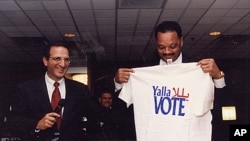
James Zogby is one of the nation's most influential Arab-American leaders.
Through the Arab American Institute, the son of Lebanese immigrants has mobilized the Arab-American electorate, taking it from the margins of American politics and forging an identity which is recognized not only by the national parties, but also by the national media and the American public.
Early start
Zogby's activism began in college and was inspired by American poet and peace activist, Daniel Berrigan:
"I was involved in civil rights and anti-war activity in the 1960's. When I was in college, I went on my first marches, was involved in organizing my first protests and demonstrations," says Zogby. "I knew of my heritage, my roots and was drawn to that but it did not come to life until the 1967 war when I realized that my commitment to peace and my commitment to civil rights should actually apply to the people from the Arab world as well."

Zogby's father came to the U.S. illegally in 1922 and became a citizen through a government amnesty program. His mother's family immigrated in 1898. She was very involved in the Arab community in Utica, New York, where the family lived.
As his involvement with the Arab-American community grew, Zogby joined or formed a number of advocacy groups such as the Association of Arab American University Graduates, the Palestinian Human Rights Campaign and the American-Arab Anti-Discrimination Committee.
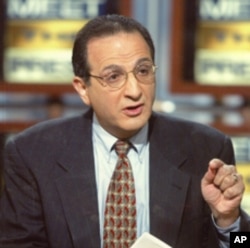
Cultural bridge
His study of Islam at Temple and Princeton Universities in the 1970s was an eye opener for him.
"The study of religion, especially the work I did later on and my post-doctoral work - which was what happens under stress to a religion, what happens to a culture under stress - was so helpful for what I do today," he says. "I think I understand the world better. I think I understand people and how they think better. I understand America better because of that work."
He shares that understanding by acting as a cultural bridge between the U.S. and the Arab world, through his weekly column explaining American politics to Arabic newspaper readers and his TV talk show on Abu Dhabi Television, which is also broadcast on American cable TV networks.
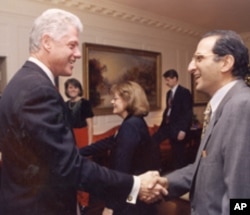
Zogby's standing as a leading spokesman for the Arab-American community was affirmed in 1984, when he addressed delegates at the Democratic National Convention in San Francisco:
"Being the first Arab-American to speak at a political convention, I got to nominate Jesse Jackson for president and stand before the world and say, 'I am an Arab-American. My Dad was an illegal immigrant from a one-room stone house in the hills of Lebanon, and I am nominating somebody for president, the great-grandson of a slave.' How much better of an American story can you get?"
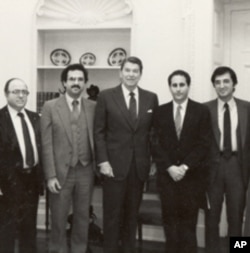
Arab American Institute
Zogby realized that Arab-Americans had to get involved in politics if they hoped to influence U.S. policy and government leaders. So, in 1985, he founded the Arab American Institute, now recognized as the political and policy research arm of the Arab-American community.
Zogby continues to be a prominent figure in the Democratic Party, serving as an advisor in the Clinton and Obama campaigns. He has testified before a number of Congressional committees about U.S. policies in the Middle East and on the civil rights of Arab and Muslim Americans.
"We have a lot of fights ahead of us, but the harder it gets, the stronger I think we are and the better we are able to deal with it. Right now, the sun is blocked by a cloud, but that cloud will pass," he says. "I have seen it happen too many times before, and ultimately at the end of the day, justice will win, the strength of our community will survive. We will overcome this mosque issue. We will overcome the hatred and discrimination. We will get justice and peace in the Middle East because there is no alternative, but we get stronger as we continue to work and fight."
And Zogby will continue to help lead that battle for Arab-American voices to emerge from the margins to become an integral part of the national discourse.