


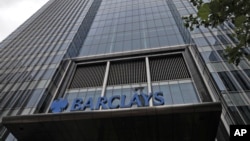
A scandal over a major British bank unfairly manipulating interest rates threatens to engulf more major banks around the world. The case has already seen Barclays Bank pay a huge fine, sparked a flurry of investigations and hearings, and might result in changes in laws that govern financial firms.
Impact
Barclays is one of 18 banks that help set a daily benchmark for many interest rates around the world by reporting what they expect to pay to borrow money. The result is called the “LIBOR” which stands for "London Interbank Offered Rate."
White-collar crime expert and former Department of Justice attorney Michael Weinstein says LIBOR has a huge impact on global commerce.
“It is fair to say it is not millions, it's not billions, it's trillions of dollars impacted by the LIBOR rate. So the impact is not only domestic here in the United States, but globally and internationally,” Weinstein said.
Some of the efforts to manipulate interest rates occurred during the financial crisis, when investors, depositors, other banks, and regulators were worried about the financial strength of banks.
Barclays paid a fine of around $450 million for, among other things, lying to rate-setting officials by saying they were paying a lower interest rate than they actually were.
Pace University expert on corporate governance, John Alan James, says Barclays misled officials because a low interest rate is a vote of confidence in a borrower by a lender.
“They come in low and it shows that they are stronger than they really are,“ James said.
On other occasions, Barclays’ officials falsely said the interest rate they had to pay was higher than it actually was, in an effort to make money on investments that were essentially a bet that the LIBOR would rise.
Both actions hurt consumers.
Manipulation
Manipulating the LIBOR interest rate higher means people were unfairly forced to pay more on mortgages, student loans and other transactions. And manipulating the interest rate lower unfairly cut the returns paid to people who rely on savings and investments with interest rates tied to LIBOR rates.
Weinstein says investigations are underway in a number of countries and the scandal could spread widely.
“I think you are going to see almost all of the world’s major banks get hit with this to some degree.”
He adds he expects governments and regulators to tighten rules and supervision of banks in response.
But Hofstra University finance professor Anoop Rai says lawmakers and regulators must strike a careful balance; too little regulation allows too many dishonest practices, but too much supervision slows commerce and hurts the economy.
“It is very difficult to get an optimal set of regulations, too much or too little, said Rai. "And over time, markets forget, and we see this recurring behavior so many times,
one just has to scratch their head and say how do we get buyers to beware.”
Nevertheless, Pace University's John Alan James expects that some actual, constructive change will come from this scandal because, as he puts it, “This is too big to put under the rug. “
Impact
Barclays is one of 18 banks that help set a daily benchmark for many interest rates around the world by reporting what they expect to pay to borrow money. The result is called the “LIBOR” which stands for "London Interbank Offered Rate."
White-collar crime expert and former Department of Justice attorney Michael Weinstein says LIBOR has a huge impact on global commerce.
“It is fair to say it is not millions, it's not billions, it's trillions of dollars impacted by the LIBOR rate. So the impact is not only domestic here in the United States, but globally and internationally,” Weinstein said.
Some of the efforts to manipulate interest rates occurred during the financial crisis, when investors, depositors, other banks, and regulators were worried about the financial strength of banks.
Barclays paid a fine of around $450 million for, among other things, lying to rate-setting officials by saying they were paying a lower interest rate than they actually were.
Pace University expert on corporate governance, John Alan James, says Barclays misled officials because a low interest rate is a vote of confidence in a borrower by a lender.
“They come in low and it shows that they are stronger than they really are,“ James said.
On other occasions, Barclays’ officials falsely said the interest rate they had to pay was higher than it actually was, in an effort to make money on investments that were essentially a bet that the LIBOR would rise.
Both actions hurt consumers.
Manipulation
Manipulating the LIBOR interest rate higher means people were unfairly forced to pay more on mortgages, student loans and other transactions. And manipulating the interest rate lower unfairly cut the returns paid to people who rely on savings and investments with interest rates tied to LIBOR rates.
Weinstein says investigations are underway in a number of countries and the scandal could spread widely.
“I think you are going to see almost all of the world’s major banks get hit with this to some degree.”
He adds he expects governments and regulators to tighten rules and supervision of banks in response.
But Hofstra University finance professor Anoop Rai says lawmakers and regulators must strike a careful balance; too little regulation allows too many dishonest practices, but too much supervision slows commerce and hurts the economy.
“It is very difficult to get an optimal set of regulations, too much or too little, said Rai. "And over time, markets forget, and we see this recurring behavior so many times,
one just has to scratch their head and say how do we get buyers to beware.”
Nevertheless, Pace University's John Alan James expects that some actual, constructive change will come from this scandal because, as he puts it, “This is too big to put under the rug. “