



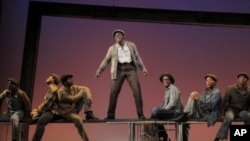
A new musical which focuses on a shameful episode in American racial history just opened on Broadway.
"The Scottsboro Boys" delves into an infamous 1930s legal case in which nine African-American teenagers were unjustly accused of raping two white women in the southern state of Alabama. The trials and appeals dragged on for almost a decade and ended up in the Supreme Court twice. The circus surrounding the case captured national attention.
The Broadway production features a score by legendary songwriters Kander and Ebb - who also created "Cabaret" and "Chicago." But can a musical based on such a grim and emotional subject be successfully made into popular entertainment?
'The Scottsboro Boys'
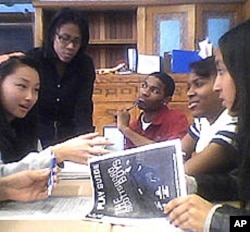
On a recent Saturday afternoon, students from Harlem's Academy for Social Action decided to find out. Their excursion to see "The Scottsboro Boys" was part of a program called Open Doors, which introduces New York City high school kids to Broadway shows. After devouring the study guide, 17-year-old Samantha Henry couldn't wait for the show to start.
"Oh, I was excited to see it because of the format of the show," she says. "Like, they put it so it's entertaining, but at the same time you get to get the real racist content of the 1930s."
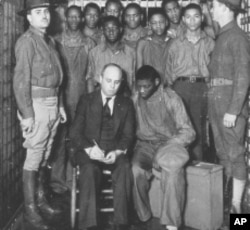
According to director Susan Stroman, the creators of the musical took their cue from lyricist Fred Ebb, who died in 2004, before the show was completed.
"He said, 'You know, if you we don't make this show entertaining, no one's gonna listen to this story. It has to be entertaining.'"
But it's entertainment that's meant to be subversive. "The Scottsboro Boys" tells its story as a minstrel show - a popular entertainment from the 19th century that featured white performers, and sometimes black ones, in blackface. Composer John Kander notes they usually played buffoonish characters.
"Doing a minstrel show today is such a racially-charged thing that it already brings its own comment with it," says Kander. "So the very form that we were working in commented on the story that we were telling."
Mixing roles
"The Scottsboro Boys" makes use of the kind of broad stylized characters typical in minstrel shows and has many of the actors playing multiple roles - including white stereotypes.
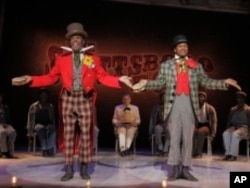
"Our black company get to play a white sheriff and white guards and white lawyers and they get to play roles that they would never be allowed to play," says Stroman, the show's director. "And that makes it sort of an acting tour-de-force for them."
As the show progresses, the perspective of the Scottsboro Boys takes over. Towards the end of the musical, the Interlocutor - a master of ceremonies and the only white person onstage - asks the Scottsboro Boys to sing a ballad, called "Southern Days."
"And they do, indeed, sing it for him, but then they take the lyrics and spin them on their heads," says Stroman. "You know, they change the sweet lyrics of the how sweet it is down south to the horrors that they have been through."
The boys sing lyrics such as, "How the sights and sounds come back to me… like my daddy hangin' from a tree."
Lasting impression
The 1930s Alabama of lynchings and cross-burnings made an impression on those in the audience, like the Harlem teenagers. Jamal Baugh found himself talking to some audience members after the show.
"Me and Shannille was talking to two old ladies who was actually in that time. They were black also. So she was saying that can we relate to it? And I was like, 'No. I'm kind of glad that we live right now,'" recounts Baugh. "And how they were saying that they were sad at seeing how this play was so emotional and how it was racism at that time. So they had it bad while we had it good, for right now."
The Theater Development Fund, which sponsors the Open Doors program, has bought out the house for two upcoming matinees of "The Scottsboro Boys." They plan to bring 1,800 high school kids to see the show.