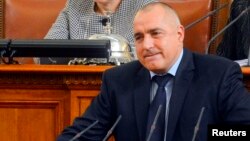
Bulgarian Prime Minister Boiko Borisov speaks in the Parliament in Sofia, February 20, 2013. Bulgaria's government resigned from office on Wednesday after nationwide protests against high electricity prices.
Bulgaria's government resigned Wednesday following violent protests fueled by outrage over rising energy prices blamed on foreign-controlled companies. Lawmakers are expected to vote on the resignation Thursday. The Cabinet in the European Union's poorest country quit amid a wider debate in Europe about EU-demanded privatization of public utilities in member states.
Prime Minister Boiko Borisov's government stepped down amid pressure from tens of thousands of protesting Bulgarians in cities across this Balkan nation of more than seven million people.
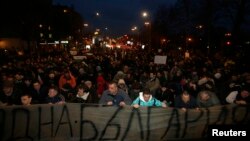
Demonstrators shouted slogans such as "Mafia!" to vent their anger after the government raised electricity prices by 13 percent, in a country where average monthly wages hover around $480.
Protestors kneel as Bulgarian national anthem is played, as they block a main boulevard during demonstration against high electricity prices in Sofia, February 20, 2013.
A rally in the capital, Sofia, turned violent Tuesday when protesters clashed with riot police, leaving some 15 people injured.
That violence shocked Borisov, who began his career guarding the Black Sea state's communist leader, Todor Zhivkov.
The former bodyguard-turned prime minister told parliament his administration resigned because he did not want to impose power by force.
Borisov said his rightist GERB party came to power in 2009 because it was the will of the people. He said his government did "the most to meet the demands of the protesters" but acknowledged there was "nothing" it could do "to help them." The prime minister also said, "Our power was handed to us by the people, today we are handing it back to them" as the state "needs leadership that has new credibility."
Borisov's move was expected to lead to early elections in April or May.
He leaves behind uncertainty about foreign investments in the country. Just before resigning, he not only fired his finance minister but cut power prices of foreign-owned companies, risking a diplomatic dispute with the Czech Republic.
In Prague, the Czech Republic's prime minister, Petr Necas, said the move conflicted with EU norms and accused Bulgaria of "politicizing" the power sector by threatening to revoke the electricity distribution license of a key Czech majority-owned company. There have also been fines for another Czech company and an Austrian power distributor.
Bulgaria's energy pricing policies have worried the European Commission, the EU's executive body, says spokesperson Marlene Holzner.
“If there is a market and the market is working, than you have the best price that is possible," she said. "It will mean that the increase that is foreseen by many, many forecasts will not be as steep. In Bulgaria, we have regulated prices both for the small and medium enterprises and also for the end users. Our position as the commission is that we would prefer to have market prices, but you can always, for a certain number of people, for very vulnerable consumers of course, have regulated prices.”
It comes amid European concerns over EU directives about opening up public services to foreign investments, ranging from the energy sector to even water suppliers.
There have been protests against these policies in several countries, including Portugal and Greece, where the EU demands the privatization of public water works in exchange for billions of dollars in crucial bailout money for the troubled economies.