


BANGKOK - Rare street protests of months of electricity cuts are being held in Burma’s second-largest city, Mandalay. Burma’s state media blames attacks by ethnic-Kachin rebels for worsening chronic power shortages.
Protesters gathered late Sunday in Mandalay, upset with power cuts that have left them with only several hours of electricity a day. Hundreds of people held a peaceful candle-lit walk through the streets and outside the local electric authority, demanding regular supplies of power.
Some reports quoted people upset with the government for selling power to China when it cannot meet its own people’s needs.
Three out of four Burmese do not have access to electricity, despite the country’s huge oil, gas and hydropower resources, much of which is sold to neighbors Thailand and China.
Monk U Wirathu took part in the demonstration and spoke to VOA’s Burmese Service.
He says they protested because officials announced electricity would be distributed only six hours a day. Previously, they were not limited to six hours, but electricity distribution was alternated either day or night.
Rangoon, the former capital, is also down to several hours of electricity a day.
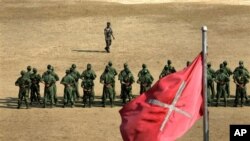
Burma’s state media blamed the rebel Kachin Independence Army for destroying part of a power grid in eastern Shan State.
The New Light of Myanmar newspaper says KIA bomb blasts over the weekend destroyed four electricity towers, reducing power nation-wide by 200 megawatts.
Colonel James Lum Dau is deputy of foreign affairs for the KIA’s political wing, the Kachin Independence Organization. He denies their army would attack the electricity grid and said authorities are always blaming the KIA.
"We are not going to do this kind of thing. We have no policy [like this]. And, again, this is the area ... is not the area we are operating. So that, I can deny that this is absolutely impossible," he said.
The KIA could not be immediately reached for comment.
Lum Dau said Burma soldiers have in recent weeks been moving in on the KIA’s headquarters in Laiza, near the Chinese border, leading to fierce clashes.
Burma’s army and the KIA have been fighting since June, when they broke a 17-year cease-fire.
Protests are rare in Burma where the military crushed democracy uprisings in 1988 and 2007. But since last year the nominally civilian government has ushered in reforms, including a law allowing peaceful protest.
The Mandalay protesters failed to get permission for the demonstration, but authorities appear to be tolerating them.
Burmese media reported the local electricity chief promised to quickly resolve the power shortage or he would resign.
Protesters gathered late Sunday in Mandalay, upset with power cuts that have left them with only several hours of electricity a day. Hundreds of people held a peaceful candle-lit walk through the streets and outside the local electric authority, demanding regular supplies of power.
Some reports quoted people upset with the government for selling power to China when it cannot meet its own people’s needs.
Three out of four Burmese do not have access to electricity, despite the country’s huge oil, gas and hydropower resources, much of which is sold to neighbors Thailand and China.
Monk U Wirathu took part in the demonstration and spoke to VOA’s Burmese Service.
He says they protested because officials announced electricity would be distributed only six hours a day. Previously, they were not limited to six hours, but electricity distribution was alternated either day or night.
Rangoon, the former capital, is also down to several hours of electricity a day.
Burma’s state media blamed the rebel Kachin Independence Army for destroying part of a power grid in eastern Shan State.
The New Light of Myanmar newspaper says KIA bomb blasts over the weekend destroyed four electricity towers, reducing power nation-wide by 200 megawatts.
Colonel James Lum Dau is deputy of foreign affairs for the KIA’s political wing, the Kachin Independence Organization. He denies their army would attack the electricity grid and said authorities are always blaming the KIA.
"We are not going to do this kind of thing. We have no policy [like this]. And, again, this is the area ... is not the area we are operating. So that, I can deny that this is absolutely impossible," he said.
The KIA could not be immediately reached for comment.
Lum Dau said Burma soldiers have in recent weeks been moving in on the KIA’s headquarters in Laiza, near the Chinese border, leading to fierce clashes.
Burma’s army and the KIA have been fighting since June, when they broke a 17-year cease-fire.
Protests are rare in Burma where the military crushed democracy uprisings in 1988 and 2007. But since last year the nominally civilian government has ushered in reforms, including a law allowing peaceful protest.
The Mandalay protesters failed to get permission for the demonstration, but authorities appear to be tolerating them.
Burmese media reported the local electricity chief promised to quickly resolve the power shortage or he would resign.