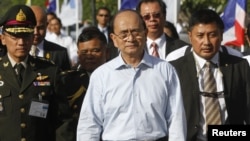
Burma has removed over 2,000 citizens from a government blacklist long used to keep exiled critics of the country's former military rulers from returning to their homeland.
The New Light of Myanmar hailed the move as a continuation of Burma's recent political and economic reforms. The state-controlled paper did not discuss the status of over 4,000 people remaining on the list, keeping many journalists, activists, and others from entering the country.
It said the ban was lifted on 2,082 of the country's 6,165 black-listed persons after "scrutinizing them in conformity with the current policies." The newspaper did not elaborate or provide detail on who the move will affect.
The news comes as Burmese President Thein Sein reshuffled his Cabinet Monday, promoting allies who back his reformist agenda.
In the long-awaited shake-up, the president awarded four of his key ministers additional posts in the Office of the President. They include the ministers of finance, rail transportation, and national planning and economic development. The ministers are seen as allies of the president who have helped to implement reforms he has promoted.
Another change is the reassignment of Information Minister Kyaw Hsan who was widely seen as close to the former military junta. He is replaced by Labor and Social Welfare Minister Aung Kyi, who has represented the government in talks with opposition leader Aung San Suu Kyi.
The reshuffle of nine ministers has been anticipated for months. A further 15 new deputy ministers are also being appointed.
The director of the Burmese President's Office, Zaw Htay, told VOA's Burmese service that the reshuffling process is just starting and will later be followed by reconstruction. "This is just the beginning, more will come. This is not the final."
President Thein Sein has faced criticism from government conservatives who are reluctant to give up the powers previously enjoyed by the military. Since taking power in March 2011, President Thein Sein has released hundreds of political prisoners, eased press restrictions, and allowed Aung San Suu Kyi to successfully run for parliament.
The New Light of Myanmar hailed the move as a continuation of Burma's recent political and economic reforms. The state-controlled paper did not discuss the status of over 4,000 people remaining on the list, keeping many journalists, activists, and others from entering the country.
It said the ban was lifted on 2,082 of the country's 6,165 black-listed persons after "scrutinizing them in conformity with the current policies." The newspaper did not elaborate or provide detail on who the move will affect.
The news comes as Burmese President Thein Sein reshuffled his Cabinet Monday, promoting allies who back his reformist agenda.
In the long-awaited shake-up, the president awarded four of his key ministers additional posts in the Office of the President. They include the ministers of finance, rail transportation, and national planning and economic development. The ministers are seen as allies of the president who have helped to implement reforms he has promoted.
Another change is the reassignment of Information Minister Kyaw Hsan who was widely seen as close to the former military junta. He is replaced by Labor and Social Welfare Minister Aung Kyi, who has represented the government in talks with opposition leader Aung San Suu Kyi.
The reshuffle of nine ministers has been anticipated for months. A further 15 new deputy ministers are also being appointed.
The director of the Burmese President's Office, Zaw Htay, told VOA's Burmese service that the reshuffling process is just starting and will later be followed by reconstruction. "This is just the beginning, more will come. This is not the final."
President Thein Sein has faced criticism from government conservatives who are reluctant to give up the powers previously enjoyed by the military. Since taking power in March 2011, President Thein Sein has released hundreds of political prisoners, eased press restrictions, and allowed Aung San Suu Kyi to successfully run for parliament.