



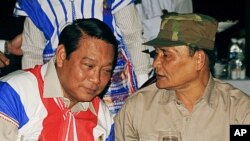
The Burmese government has signed a cease-fire with the ethnic Karen rebel group, in an apparent move toward ending one of the world's longest-running insurgencies and meeting a key condition for improved ties with the West.
The two sides signed the deal Thursday after a series of meetings in Pa-an, the capital of Karen state in southeast Burma. The agreement marks the first declared break in fighting between the government and the rebel force since just after the country gained independence from Britain in 1948. Details were not immediately disclosed.
Talks between the government and Karen National Union leaders intensified last year, as the new, nominally-civilian government publicly offered the possibility of reconciliation with a myriad of ethnic groupings.
The rapprochement gained momentum in November when U.S. Secretary of State Hillary Clinton visited the Southeast Asian nation. She said such truces with ethnic groups would help pave the way for a deal with Washington to ease economic sanctions imposed on Burma during decades of military rule.
Karen leaders say years of government aggression have subjected their people to human rights abuses that include forced labor, looting, extortion and destruction of property. Thousands of villagers have been forced to flee to escape the fighting, with many of them currently living in refugee encampments just across the Thai border.
Burma's long-reigning military junta, which stepped aside last year, justified its crackdown as a way of maintaining stability and unity.
The government in December signed a preliminary cease-fire with another key ethnic grouping, the Shan State Army. It has also reached cease-fire deals with several other ethnic groups, but tensions remain with various other factions. Additionally, it has released about 200 of more than 1,000 political prisoners jailed by the junta and thought to be languishing in Burmese prisons.
Since coming to power in 2010, the government has also unveiled for the first time new peace proposals to rebel groups that call for cease-fires followed by development assistance and a national conference to discuss political grievances.
Some information for this report was provided by AP, AFP and Reuters.