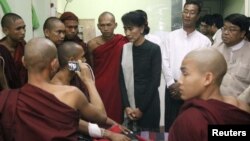
Burmese pro-democracy leader Aung San Suu Kyi visits Buddhist monks, wounded in a police crackdown on activists fighting a Chinese copper mine project, at a hospital in Monywa, Nov. 29, 2012.
Burmese opposition leader Aung San Suu Kyi has offered to mediate a dispute involving villagers and monks opposed to the expansion of a Chinese-backed copper mine in the country's northwest.
She made the offer Thursday as she visited the mine, hours after police used water cannons, tear gas and smoke bombs to drive away hundreds of anti-mine protesters who had occupied the area for 11 days.
A monk who joined the protesters in the town of Monywa said in an interview with VOA that at least 20 other monks suffered burns during the police operation and had to be hospitalized. Witnesses said the burns resulted from devices fired by security personnel as they raided several protest camps around 3:00 a.m. local time.
Buddhist monks are treated at a hospital in Monywa after a police crackdown on protesters at a controversial copper mine, Nov. 29, 2012.
Burmese President Thein Sein's office initially denied police used excessive force or dangerous chemicals in the operation, but a spokesman said the president ordered the statement to be retracted after several hours.
The evicted protesters were among hundreds who had defied a government order to end the occupation-style protest. Protesting villagers and monks say planned mine expansion threatens their environment. They also accuse authorities of unlawfully seizing land for the $1 billion project.
Speaking to thousands of villagers near the copper mine later in the day, Aung San Suu Kyi said she met with the mine's operators and wants to speak to the protest leaders as well.
"I wish to find a peaceful resolution to the problem we are facing today at this copper mine project," she said. "It should be solved in the best interests of our people, by protecting our country's dignity and our future. I will try my best to achieve this. Although I cannot guarantee whether I will succeed or not, I believe that if the people work together with me, we can succeed."
In her speech, the Nobel Peace Prize winner made no criticism of the security crackdown. She later went to a nearby hospital where many of the injured were being treated.
Burma's government says mine operations were suspended November 18 because of the protest. It says canceling the project would discourage much-needed foreign investment.
The mine is a joint venture between a Chinese arms manufacturer and a business controlled by the Burmese military.
Chinese foreign ministry spokesperson Hong Lei defended the planned mine expansion in his Thursday briefing.
"The relocation, compensation, environmental protection and other issues involved with this project were jointly settled through negotiations by the Chinese and Myanmar sides and meet Myanmar's laws and regulations," Hong said. "We hope all levels of Myanmar society can provide an environment beneficial to the project's development."
China's Communist Party-run Global Times newspaper warned that a suspension of the joint venture will be a "lose-lose situation" for China and Burma. It accused "some Westerners and NGOs" of instigating the protests.
In an interview with VOA, Human Rights Watch Burma researcher Matthew Smith called those claims "baseless." He said villagers had legitimate concerns about the project even before it was associated with the Chinese company.
"If you really look on the ground, people have suffered, people are losing their livelihoods, they are losing their land that not only they call home, but has been called home to their ancestors for a very long time," Smith said. "So taken together, all of these issues are really underpinning it. I don't think this is some intricate plot by Western governments and non-governmental organizations."
Smith added there is an "urgent need for authorities to proceed in a way that protects human rights, and at the moment there are a lot of concerns that is not happening."
The Voice of America provides news and information in more than 40 languages to an estimated weekly audience of over 326 million people. Stories with the VOA News byline are the work of multiple VOA journalists and may contain information from wire service reports.