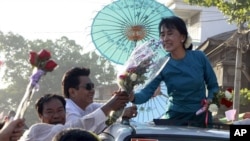



As the campaign for Burma’s by-election heats up, the party of Nobel Peace Laureate Aung San Suu Kyi is the dominant face of the political opposition.
Crowds of adoring supporters have been gathering across the country at campaign rallies to catch a glimpse of Aung San Suu Kyi.
Although she draws the most interest, other candidates in her National League for Democracy party, such as AIDS activist Phyu Phyu Thin, are getting a taste of the attention.
The rally song says Aung San Suu Kyi's party has come back to serve the people and Phyu Phyu Thin will do the same.
The NLD was conspicuously absent from the ballots and campaign trails during the 2010 election and its return has brought palpable elation during lively street rallies.
Daw Kyi Kyi Win, is one rally-goer who has adorned her face and clothes with stickers. As she waved flags bearing the NLD’s fighting peacock emblem, she said she is even considering becoming an NLD member herself - a decision that would have been considered extremely risky just one year ago.
She says she thinks Aung San Suu Kyi can win, by a big margin and that makes her happy. She says she never thought that such political openness was possible.
Not everyone is elated at Aung San Suu Kyi’s return. There are other opposition parties who lack the star-power and the funding of the NLD.
Tae Yi, is the man faced with the unenviable task of running against Suu Kyi in Kawhmu. He pursued a legal case questioning the legitimacy of her candidacy, until a ruling this week rejected his challenge and placed her on the ballot.
He says he has no personal grudge against Aung San Suu Kyi and that he's glad to be running against her.
The 80 year-old candidate says his platform includes addressing democracy and human rights issues. Despite the court rulings against his challenge to Suu Kyi, his Unity and Peace Party says it is still challenging her legitimacy.
The incumbent politician in the Kawhmu township is a representative of the Union Solidarity and Development Party, a proxy party for the old government which has an overwhelming majority of parliament seats. The USDP candidate has not lodged a complaint against Aung San Suu Kyi.
The April First elections will fill just 48 vacant parliament seats, well short of the number needed to challenge the ruling party’s legislative power. But one month before polls, the strong show of support for the National League for Democracy and its high profile leader have demonstrated that, despite some 20 years spent largely on the political sidelines, the party still commands a significant public following.
Burmese Focus on Aung San Suu Kyi's Campaign Trail