


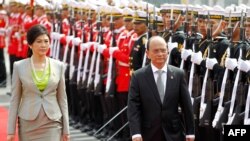
BANGKOK — Burma President Thein Sein is in Thailand, where he signed several key economic agreements with Thailand’s prime minister. One of the projects, a long-planned deep sea port, still faces obstacles.
Thai Prime Minister Yingluck Shinawatra and Burmese President Thein Sein signed three memorandums of understanding during the president's first trip to Thailand since he took office in 2010.
The agreements included a pledge of the Thai government to help the Burmese government prepare for its role when it assumes the chair of the Association of Southeast Asian Nations in 2014.
Yingluck stressed to reporters that it was especially important to the Thai government that concrete progress be made on the Dawei deep sea port, a project in southern Burma that would allow ships traveling from the Indian Ocean to avoid the Malacca Straits.
She says the two sides agreed that there will be connectivity between the Dawei deep sea port with the Laem Chabang deep sea port in Thailand. She says they have also discussed the development of industrial areas in the Dawei area and development of the eastern seaboard on the Thai side.
ItalThai, the parent company of the project's main developer, has had trouble coming up with funds and MaxMyanmar, the Burmese conglomerate acting as a local implementing partner, shocked investors when it pulled out of the project last month.
Although the port could reduce traffic in the Malacca straits and provide China with an alternative route for oil transport, the benefits of the project to the Burmese economy are not as clear.
Sean Turnell of Australia's Macquarie University points out that Thailand's economy stands to benefit from the project more than Burma's. "All the advantages go to Thailand rather than to Burma. Because really this is about getting quick access to Bangkok and some of the manufacturing outlets of Thailand and natural resources and all sort of things into the country. It's on a tiny arm of Burma," said Turnell. "I mean it really involves really little in the way of Burma's industrial capacity, for instance, or access to Burmese markets."
Burma’s rice export industry has long sought a deep sea port to boost business. But the Dawei deep sea port is too far away from the Irrawaddy river basin, which contains Burma's richest farm land. Yingluck pledged to offer support for the Burmese rice industry, but did not offer specifics.
The two leaders also discussed possibilities for opening additional border crossings, cooperation in economic and infrastructure development, Burmese migrant labor in Thailand and the fight against narcotics.
Yingluck also welcomed the developments taking place in Burma under President Thein Sein's leadership.
Political and economic reforms under the Thein Sein government have lead to increased foreign investment, but rights groups are still quick to admonish the government for its human rights record.
The Burmese Rohingya Association of Thailand staged a protest Monday during the two leaders’ meeting, demanding the Yingluck government pressure Thein Sein to lift the state of emergency in Rakhine state, where ethnic and sectarian violence broke out last month between ethnic Rohingyas and ethnic Rakhines.
Benjamin Zawacki of Amnesty International says that the overall rights situation in Burma, also known as Myanmar, has gotten worse in the past year, despite the landmark political reforms.
"President Thein Sein simply asserts that Rohingyas are not citizens and then, regardless of their actual status, he's currently allowing security forces under the rubric of the state of emergency to commit violations against that ethnic minority. And ,I would point out that it's a glaring mark on the country's human rights record and certainly runs counter to the prevailing narrative that human rights are being improved in Myanmar, across the board."
President Thein Sein will be meeting leaders of the Burmese community in Thailand during a visit to the country's embassy Tuesday, before he returns home.
Thai Prime Minister Yingluck Shinawatra and Burmese President Thein Sein signed three memorandums of understanding during the president's first trip to Thailand since he took office in 2010.
The agreements included a pledge of the Thai government to help the Burmese government prepare for its role when it assumes the chair of the Association of Southeast Asian Nations in 2014.
Yingluck stressed to reporters that it was especially important to the Thai government that concrete progress be made on the Dawei deep sea port, a project in southern Burma that would allow ships traveling from the Indian Ocean to avoid the Malacca Straits.
She says the two sides agreed that there will be connectivity between the Dawei deep sea port with the Laem Chabang deep sea port in Thailand. She says they have also discussed the development of industrial areas in the Dawei area and development of the eastern seaboard on the Thai side.
ItalThai, the parent company of the project's main developer, has had trouble coming up with funds and MaxMyanmar, the Burmese conglomerate acting as a local implementing partner, shocked investors when it pulled out of the project last month.
Although the port could reduce traffic in the Malacca straits and provide China with an alternative route for oil transport, the benefits of the project to the Burmese economy are not as clear.
Sean Turnell of Australia's Macquarie University points out that Thailand's economy stands to benefit from the project more than Burma's. "All the advantages go to Thailand rather than to Burma. Because really this is about getting quick access to Bangkok and some of the manufacturing outlets of Thailand and natural resources and all sort of things into the country. It's on a tiny arm of Burma," said Turnell. "I mean it really involves really little in the way of Burma's industrial capacity, for instance, or access to Burmese markets."
Burma’s rice export industry has long sought a deep sea port to boost business. But the Dawei deep sea port is too far away from the Irrawaddy river basin, which contains Burma's richest farm land. Yingluck pledged to offer support for the Burmese rice industry, but did not offer specifics.
The two leaders also discussed possibilities for opening additional border crossings, cooperation in economic and infrastructure development, Burmese migrant labor in Thailand and the fight against narcotics.
Yingluck also welcomed the developments taking place in Burma under President Thein Sein's leadership.
Political and economic reforms under the Thein Sein government have lead to increased foreign investment, but rights groups are still quick to admonish the government for its human rights record.
The Burmese Rohingya Association of Thailand staged a protest Monday during the two leaders’ meeting, demanding the Yingluck government pressure Thein Sein to lift the state of emergency in Rakhine state, where ethnic and sectarian violence broke out last month between ethnic Rohingyas and ethnic Rakhines.
Benjamin Zawacki of Amnesty International says that the overall rights situation in Burma, also known as Myanmar, has gotten worse in the past year, despite the landmark political reforms.
"President Thein Sein simply asserts that Rohingyas are not citizens and then, regardless of their actual status, he's currently allowing security forces under the rubric of the state of emergency to commit violations against that ethnic minority. And ,I would point out that it's a glaring mark on the country's human rights record and certainly runs counter to the prevailing narrative that human rights are being improved in Myanmar, across the board."
President Thein Sein will be meeting leaders of the Burmese community in Thailand during a visit to the country's embassy Tuesday, before he returns home.