


The booming tourism industry in Cambodia, particularly in Siem Reap, has brought prosperity and abundant job opportunities to Cambodians in recent years, thanks to the lure of its 12th century Angkor temples located just outside the town.
The town is the biggest contributor to Cambodia's tourism industry, having seen 2.5 million tourist arrivals in 2010. This, in turn, has significantly boosted the local economy.
The strength of Asian economies is indicated by the influx of tourists from this region, while travelers from Europe have declined. Official statistics from the Cambodian Tourism Ministry has shown that visitors from China and Korea increased 50 percent and 46 percent in 2010, while tourists from the United Kingdom and United States declined three percent and eight percent, respectively.
Siem Reap's old market area has a touch of French influence in its architecture, having been colonized by France in the 17th century. While the facade of the shops have been relatively unchanged, the town is now filled with bars serving $1 beers and quaint cafes serving frozen yogurt and sandwiches to foreign tourists.
The latest additions to the town is the mushrooming number of Chinese and Korean restaurants that specially cater to the rising number of tourists from those countries.
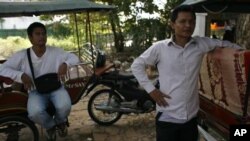
Serving Siem Reap's tourism industry are Cambodians that work in hotels, restaurants and as tuk-tuk drivers that can be found on just about every corner of the town. Tuk-tuks are auto-rickshaws, a popular mode of transportation and easy to maneuver on the town's pot-holed roads.
But the rising number of Asian tourists is not a boon to the tuk-tuk drivers in Siem Reap.
Chan, 24, a tuk-tuk driver said as more Asian tourists and fewer European tourists come to Cambodia, businesses for these drivers are also generally slowing down. “Asian tourists tend to arrive in groups via tours, so they don't need tuk-tuks to get around,” he said.
Several years ago, tuk-tuk drivers are able to command between $12 and $15 from customers for a full-day visit to the Angkor temples. But all that has changed. Chan said he would be lucky to get $8 from a customer nowadays, even though November generally has the most tourist arrivals as the town welcomes the cool season.
Another tuk-tuk driver, Sambath, said driving was once one of the more desirable jobs in the tourism and services-related industry because the drivers were higher paid compared with those working in hotels and restaurants. But, that is no longer the case.
“On a good month, we get between $100 and $200. Sometimes, we get nothing a month,” he said.
While demand is sinking, costs for tuk-tuk drivers continue. Sambath has recently invested in a new tuk-tuk and motor, that cost him close to $2,000. Drivers are also required to pay the government $5 annually to renew their operating licences.
According to Sambath, living expenses in Siem Reap have risen, especially in the areas of housing and food, making it more difficult for the working class to make ends meet. He said more than a third of drivers' salaries go to room rentals, as most of them come from villages in search of better job opportunities in Siem Reap.
Tuk-tuk drivers are also more vulnerable toward fluctuation in oil prices, given that fuel is a variable cost to them.
Nevertheless, Chan is fortunate to have a small rice field that belongs to his family. “The flood in the past few months have destroyed the rice that my family has planted as well. But, we are starting to plant again and the rice should sell at a better price because there is likely to be a shortage in supply,” he said.
However, Chan said he is adamant about not returning to his village to become a farmer. “It's too much hard work. At least, as a tuk-tuk driver, if there is no business, I can pull up a hammock by my tuk-tuk and rest,” he said.
Sambath said he was also reluctant to become a migrant worker, as he has heard stories of abuse and cheating by overseas employers from his friends.
“It is still safer to work in your own country. At least you know your surroundings and people here speak the same language as you do,” he said.
Sambath said he is also learning to be smarter about getting customers. He is reachable not just by phone, but also via his Gmail account.
“You have to use all ways to get customers. Money won't fall from the sky just like that,” he said, while hollering at a Western tourist to promote his transportation services.