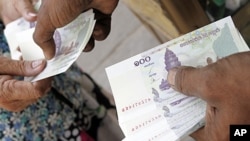



Earlier this month the Cambodian government announced that as part of its anti-corruption drive, it had outlawed the payment of fees to civil servants. But the move has opened a new set of problems that worry Western businesses that operate in the country.
To the government, this was expected to be a minor announcement. As of August 1, all corruption offenses contained in two separate laws were now in force.
For Phnom Penh, this was another step on the road to combating corruption.
The problem is that the move has effectively outlawed "facilitation fees," payments that are critical for doing business in Cambodia. Anyone who pays them can be jailed for 10 years, while the person receiving them can get 15 years.
But what exactly is a facilitation fee?
"Facilitation fees are what are paid basically to low-ranking government officials to assist in doing their job," said Matthew Rendall, the managing partner at Sciaroni & Associates, a law firm in Phnom Penh. "No advantage and nothing illegal is being obtained. And you are basically having to pay these in order to do legitimate business."
He says these fees are not exorbitant and most businesses routinely pay them.
"It is day-to-day nickel-and-dime payments made to supplement the salaries of government workers who otherwise you know would not have enough," Rendall added. "You know it could be $2 for a form, $5 to submit it, $20 to put your monthly tax filing in."
In other words, these are payments made to process paperwork. They are not bribes. They are the sorts of fees that in other countries are paid to get a passport renewed or a license issued.
The difference is that other countries list those fees on a schedule and issue a receipt. In Cambodia, a customer pays the civil servant, who pockets the fee.
Cambodia's civil servants have long relied on facilitation fees, because their salaries are typically around $50 a month, far below what they consider a livable wage.
Stephen Higgins is the chief executive officer of ANZ Royal Bank, a part-owned subsidiary of Australian banking giant ANZ. He explains why outlawing the payment of facilitation fees is a problem.
"It is a major issue for business because theoretically if any business pays them, they are liable to face criminal charges and the person paying them is liable to five years jail or more," said Higgins. "And for a business such as ours, if we were to pay them then theoretically I would be liable to go to jail here in Cambodia, in Australia, in the U.K. and in the U.S. And I certainly don't wish that upon myself."
While it is unlikely that the Cambodian government would prosecute investors for paying facilitation fees, outlawing them has effectively triggered other anti-corruption regulations in Western nations.
U.S. and Australian law allowed companies to pay such fees provided they were not illegal in the country where the payment was made.
Now that they are illegal in Cambodia, any U.S. or Australian firm paying facilitation fees here is opening itself up to prosecution at home.
Rendall says the result is that Western businesses simply cannot risk paying them. He adds that investors have long asked the Cambodian government to formalize this system by drafting a schedule of fees and issuing receipts. There is now a pressing urgency to do so.
"I mean we are scrambling to get the government to implement practices so that those payments are receipted or scheduled at least," Rendall explained.
Once those fees are legal, Western businesses will be able again to pay them. But finding out what action the government will take is tricky. No government official responded to numerous requests for clarification of the policy.
Such ambiguity gives investors from Western nations pause and is already having an impact.
Last month, courier company FedEx said it would not deliver any items worth more than $300 until the government instituted a schedule for payments for more valuable goods.
Matthew Rendall says the situation could eventually skew the business climate to favor investors from Asia.
"Those countries that have foreign corrupt practices laws - the United States, the Western countries, etcetera - are at a massive disadvantage now," said Rendall. "So the one impact it has had: Does it basically result in a situation where Cambodia finds itself almost exclusively with Chinese, Vietnamese-type investors who are not susceptible back home to being prosecuted, and excluded from OECD-type countries? Absolutely. It is a concern, it has been raised."
Although that result does not appear to be the intention of the law, Rendall says it could be an unforeseen consequence unless the government finds a way to resolve the problem.
Cambodian Anti-Corruption Drive Creates Headache for Western Firms