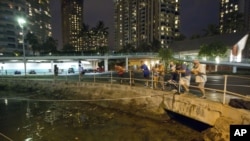
Forecasters have lifted a tsunami warning for the U.S. state of Hawaii, following Saturday's major earthquake off the coast of Canada.
The Hawaii-based Pacific Tsunami Warning Center says the tsunami threat has decreased and is now just an advisory. But the center warned sea-level changes and strong currents could still happen and would present a hazard for swimmers and boaters.
Saturday's 7.7-magnitude earthquake generated mild tsunamis, causing no major damage along the coasts of the U.S. states of California and Hawaii, as well as southwestern Canada.
The threat of worse waves had caused Hawaii Governor Neil Abercrombie to declare a state of emergency and prompted residents and tourists to move to higher ground. Authorities also had warned people along Canada's coast and the U.S. coastal regions of southeastern Alaska, northern California and southern Oregon.
A tsunami is a series of long ocean waves that can remain a danger for many hours after the initial wave. Each wave crest can last from five to 15 minutes or longer and extensively flood coastal areas.
Tsunami wave heights cannot be predicted and the first wave may not be the largest. Debris carried by a tsunami also increases its destructive power.
The Hawaii-based Pacific Tsunami Warning Center says the tsunami threat has decreased and is now just an advisory. But the center warned sea-level changes and strong currents could still happen and would present a hazard for swimmers and boaters.
Saturday's 7.7-magnitude earthquake generated mild tsunamis, causing no major damage along the coasts of the U.S. states of California and Hawaii, as well as southwestern Canada.
The threat of worse waves had caused Hawaii Governor Neil Abercrombie to declare a state of emergency and prompted residents and tourists to move to higher ground. Authorities also had warned people along Canada's coast and the U.S. coastal regions of southeastern Alaska, northern California and southern Oregon.
A tsunami is a series of long ocean waves that can remain a danger for many hours after the initial wave. Each wave crest can last from five to 15 minutes or longer and extensively flood coastal areas.
Tsunami wave heights cannot be predicted and the first wave may not be the largest. Debris carried by a tsunami also increases its destructive power.