



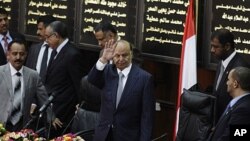
Al-Qaida is claiming responsibility for a suicide-bombing Saturday in the southern Yemeni port city of Mukalla, which left at least 26 people dead and at least 20 others wounded. The bombing came just hours after a speech by Yemen's new President Abd-Rabbu Mansour Hadi, who is originally from the south of the country.
Witnesses say the suicide car-bomber broke through an outer barrier at a presidential compound in Mukalla blowing up himself and his vehicle, near a group of soldiers who were eating, causing dozens of casualties.
Al Arabiya TV reported that the car-bomber was from Saudi Arabia and belonged to al-Qaida. A caller told the Reuters news agency that the bombing was “retaliation” for the Yemeni army's alleged “crimes.” The attack against a prominent government building, and targeting government troops, came just hours after Yemen's new President Abd-Rabbu Mansour Hadi had addressed the nation.
In his speech Mr. Hadi told parliament that fighting al-Qaida will be a major goal of his new administration.
He said the coming period requires a sincere dialogue, which will define the new leadership, based on the new constitution, embodying Yemen's national aspirations, and pushing the country from a traditional legitimacy to a new national legitimacy.
The new president stressed the continuation of the war against al-Qaida must be considered a religious and national duty, aiming at the return of the displaced to their homes and cities.
President Hadi, a former army general and vice president who hails from southern Yemen, replaced outgoing President Ali Abdullah Saleh, who came to power in 1978. Last weeks' presidential election, in which Mr. Hadi was the only candidate, took place in accordance with a Gulf Cooperation Council peace plan, signed last November.
That plan put an end to months of street protests, coupled with a tribal power struggle which ravaged parts of the capital Sana'a and left hundreds dead. Former President Saleh, who has just returned from a trip to the U.S. for medical treatment, told Yemenis that he was sorry for the months of conflict:
He said what's happened has happened, and he's sorry for it, calling the months of unrest part of an outside plot, and claiming that all the bloodshed was the result of the inflated egos of others.
Stephen Steinbeiser of the American Institute for Yemeni Studies notes that Yemenis often simplify the violence in their country by attributing it to “al Qaida,” but that the origins of the groups involved and the struggles they wage are usually very complicated. “One of the problems with Yemen right now is that there are all of these different types of groups and factions and roving gangs and there are these names thrown about, but it's unclear which groups have coalesced around which ideologies, or which people have coalesced into which groups," he said.
Steinbeiser notes that this upsurge of violence in southern Yemen is an “alarming development,” but points out that the southern separatist movement has until now distanced itself from such attacks, “because it's not in their interest to be violent.”
President Hadi will be officially inaugurated on Monday. He is expected to oversee a two-year political transition, which will also include parliamentary elections, a new constitution, and a re-organization of the military, which is still run by many Saleh loyalists, including his son and nephews.