Diplomats Make Last Ditch Effort to Talk With CAR Rebels
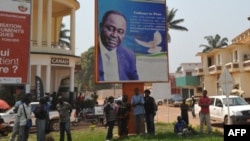
People stand under the poster of Central Africa Republic's President Francois Bozize in Bangui on December 28, 2012
Central African countries are working Friday to open talks between the government of the Central African Republic (CAR) and the rebel coalition that has seized 10 key towns in the north in the past three weeks. The rebels are threatening to march on the capital, Bangui, and topple the government if the president does not negotiate.
The Seleka Coalition
The Seleka Coalition
-Made up of several rebel factions
-Aims to remove President Francois Bozize
-Accuses Bozize of failing to honor cease-fire
-Seized 10 towns in December
The rebel group, known as Seleka, began its lightning offensive in the north on December 10 and is now within 300 kilometers of the capital, Bangui.
All that remains between the rebels and the capital are a few hundred Chadian forces and a regional peacekeeping force, called FOMAC, from the Economic Community of Central African States, which said Thursday that it is sending in reinforcements.
The United States has temporarily closed its embassy in Bangui and evacuated its ambassador and staff due to security concerns.
Analysts say the government forces are outmatched and have not put up much of a fight.
Regional diplomats are meeting in Bangui Friday to try and pave the way for peace talks that will ultimately be held in Gabon's capital, Libreville, though no date has been announced. The rebels say they have halted their advance to wait for negotiations, however they have broken similar promises in the past week.
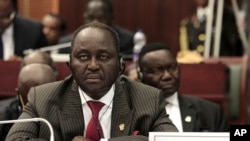
Central African Republic President Francois Bozize, June 30, 2011.
President Francois Bozize says he will negotiate but only if the rebels withdraw from the captured territory. The rebels say they will not withdraw before negotiations.
Bozize spoke publicly Thursday for the first time since the start of the rebellion.
The president called on France and the United States to help fight off the rebels so that talks can take place in Libreville. He accused the rebels of plotting with the political opposition against the government.
Analysts say the rebels appear to be well-armed, and the question of who is financing them remains unanswered.
France, which has about 200 soldiers in Bangui, says that it will not intervene, and that its forces are there to protect French interests.
Lydie Boka, head of the Paris-based risk analysis firm Strategico, said France and longtime ally Chad appear to have stepped back from Bozize, and his government is in real danger.
Boka says negotiations remain possible. She says for the president, the best case scenario could be being forced to enlarge his government, while the worst case could be a forced resignation.
Seleka unites fighters from as many as four rebel groups in the north. Many of them were involved in a four-year conflict that officially ended with peace accords in 2007, though fighting has repeatedly flared up in the north since 2009.
Seleka says the government must fully implement 2007 and 2011 peace accords that included paying rebel fighters to disarm and integrating them into the army.
Boka said the rebels have, for now, found a common objective but are far from unified.
She says in September of last year, two of the groups in the coalition — the UFDR and the CJPJ — fought a deadly battle in the diamond mining town of Bria over control of that industry. These groups, she says, are hardly dear friends or people who are going to bring a miracle solution to the immense problems of the country.
The U.N. Security Council has condemned the rebel attacks in the north.
Bozize, himself a former army chief, first came to power in 2003 after overthrowing the previous government.