


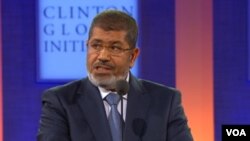
Egyptian President Mohammed Morsi Tuesday addressed the closing session of the Clinton Global Initiative’s annual meeting. He spoke of the challenges facing his government and the region.
President Morsi said Egypt, the Middle East and the world at large are at a “critical junction in history.”
“Egyptian society is presently undergoing a profound transition from dictatorship to democracy. It’s not easy to do this,” he said.
He said to move from social economic injustice to social equity, Egypt will rely on its people, who he describes as the “ultimate guarantors of success.” But Morsi said his country will also rely on “partners beyond Egypt’s borders” for assistance.
He said his country faces many challenges, but also many opportunities.
“Can we pass off to our children a world better than the one we were handed? I think we can. The answer, of course, is yes. It must be yes,” he said.
He said Egyptians rose up in 2011 with the “straightforward demands of freedom, dignity, democracy and justice.” The world, he said, is in desperate need of a global governance model that “helps people everywhere to live free.”
“Free of fear. Free of oppression and domination. Free of poverty. Free of disease. Free of ignorance. We need a global governance model that allows people to hope and allows them to translate those hopes into reality,” he said.
Such a model of global governance, he said, cannot be found in Syria or Gaza. The Arab Spring, he says, occurred because people realized they are the “real source of power.”
“We must never again find ways to whitewash or cover up torture or abuse,” he said.
The Egyptian leader also addressed the recent violence in the Muslim world. The violence led to the deaths of the U.S. ambassador to Libya and three other Americans. It was sparked by a video on YouTube mocking Islam and the Prophet Muhammad.
He said, “While we must acknowledge the importance of freedom of expression, we must also recognize that such a freedom comes with responsibilities, especially when it has serious implications for international peace and stability. Humanity’s universal heritage is a shared one that doesn’t belong to a single color, creed or culture.”
He added if people desire to coexist and prosper, they must live together, not dominate one another.
President Morsi said Egypt, the Middle East and the world at large are at a “critical junction in history.”
“Egyptian society is presently undergoing a profound transition from dictatorship to democracy. It’s not easy to do this,” he said.
He said to move from social economic injustice to social equity, Egypt will rely on its people, who he describes as the “ultimate guarantors of success.” But Morsi said his country will also rely on “partners beyond Egypt’s borders” for assistance.
He said his country faces many challenges, but also many opportunities.
“Can we pass off to our children a world better than the one we were handed? I think we can. The answer, of course, is yes. It must be yes,” he said.
He said Egyptians rose up in 2011 with the “straightforward demands of freedom, dignity, democracy and justice.” The world, he said, is in desperate need of a global governance model that “helps people everywhere to live free.”
“Free of fear. Free of oppression and domination. Free of poverty. Free of disease. Free of ignorance. We need a global governance model that allows people to hope and allows them to translate those hopes into reality,” he said.
Such a model of global governance, he said, cannot be found in Syria or Gaza. The Arab Spring, he says, occurred because people realized they are the “real source of power.”
“We must never again find ways to whitewash or cover up torture or abuse,” he said.
The Egyptian leader also addressed the recent violence in the Muslim world. The violence led to the deaths of the U.S. ambassador to Libya and three other Americans. It was sparked by a video on YouTube mocking Islam and the Prophet Muhammad.
He said, “While we must acknowledge the importance of freedom of expression, we must also recognize that such a freedom comes with responsibilities, especially when it has serious implications for international peace and stability. Humanity’s universal heritage is a shared one that doesn’t belong to a single color, creed or culture.”
He added if people desire to coexist and prosper, they must live together, not dominate one another.