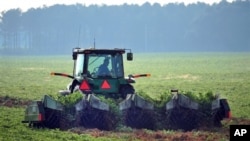
Ray Morris plows up peanuts at his farm near Leesburg, Ga., on Thursday, Oct. 25, 2012. US farmers are expected to bring in more than two-thirds more peanuts than they did in 2011.
There’s a battle of the sandwiches going on in Congress. At issue is the shape of the safety net program for America’s farmers.
On one side: peanut butter, the favorite sandwich spread of American childhood.
On the other side is the upstart, hummus, a Middle Eastern spread made with chick peas.
“It’s really one of the fastest-growing snack foods in the U.S.,” says Tim McGreevy, who runs the farm lobby group, USA Dry Pea and Lentil Council, adding that hummus is finding new places on the American menu. “[It] started out as a dip and now it’s moving into a spread. People put it on sandwiches and pitas.”
Protecting an abundant, affordable supply of sandwich fixings -along the rest of the food supply- has been a cornerstone of U.S. policy for decades.
Safety net
To protect crop growers, the government pays about $5 billion a year in subsidies meant to help smooth out the ups and downs of weather and markets.
These days, markets are up for many crops; some are near record highs.
Washington lawmakers, however, are looking for ways to cut spending.
“They’ve been hearing supposedly farm income is up," says economist Stanley Fletcher, head of the University of Georgia’s National Center for Peanut Competitiveness, "and they say we shouldn’t be sending payments out there when times are good.”
So, these payments are almost certain to end when lawmakers write new farm legislation.
Farmers who grow chick peas, which is used to make hummus (above), worry a proposed farm bill encourages growers to plant whatever crop would give the biggest federal payout, rather than what the market calls for.
According to Fletcher, the House of Representatives proposes replacing the current subsidy with another system in which, if commodity prices fall below a certain point, the government would pay farmers most of the difference.
“It gives them a safety net in terms of where they can at least cover some of their costs of production," Fletcher says. "So at least they can, you know, not go bankrupt that year.”
Getting away from what the market calls for
Southern peanut and rice farmers back this proposal. It would cover other crops, too, from corn and soybeans to chick peas.
But chick pea farmers, for one, don’t like it.
“If they want their support prices, that’s fine, but don’t tie the rest of us to it,” says Kim Murray, lead farmer at the USA Dry Pea and Lentil Council. He says the House proposal encourages farmers to plant whatever crop would give the biggest government payout, not what the market calls for.
Murray thinks that’s not a good way to farm. Plus, he says, it's illegal.
“They’re going to get us into hot water with the WTO and I don’t know what the House is thinking on that.”
Hot water
The WTO (World Trade Organization) mediates international trade disputes and the U.S. is already in trouble with the world body over farm subsidies.
The new farm bill is supposed to fix the WTO problems.
In June, the Senate passed a bill that does not include support payments, but critics argue it's not much better than the House version.
"Both the Senate and the House proposals tie new subsidies to current production decisions. So the more land you plant, the more subsidy you will get," Montana State University economist Vince Smith says. "Those are precisely the sort of subsidies that we're not supposed to introduce under the WTO agreement."
Still, chick pea farmers prefer the Senate bill. So do corn and soybean farmers. Peanut and rice farmers back the House version.
For now, like so much else in the U.S. Congress, the battle between hummus and peanut butter is at an impasse.