News / Science & Technology

Chimpanzee Minds Are Like Humans, Better in Some Ways

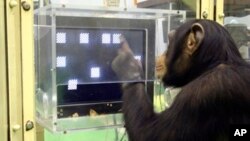
A chimpanzee named Ayumu performs the second stage of a memory test in which he must recall the location on a touch sensitive monitor of numerals that have changed to blank squares, at the Primate Research Institute in Kyoto, Japan, Dec. 13, 2006.A chimpanzee named Ayumu performs the second stage of a memory test in which he must recall the location on a touch sensitive monitor of numerals that have changed to blank squares, at the Primate Research Institute in Kyoto, Japan, Dec. 13, 2006.
x
A chimpanzee named Ayumu performs the second stage of a memory test in which he must recall the location on a touch sensitive monitor of numerals that have changed to blank squares, at the Primate Research Institute in Kyoto, Japan, Dec. 13, 2006.
TEXT SIZE - +
At Kyoto University's Primate Research Institute, a chimpanzee named Ayumu is performing a task that is impossible for a person to do, revealing how chimp cognition can mirror - and in some cases surpass - the capabilities of the human brain.

Sitting in front of a computer monitor that briefly displays the numbers one through nine in a random pattern, the chimp touches the number one. The remaining digits are immediately hidden behind white squares. But Ayumu can touch where each number was, in ascending order - 2, 3, 4, and so on. People cannot remember the location of more than a few numbers.

At the annual meeting in Boston of the American Association for the Advancement of Science, researcher Tetsuro Matsuzawa showed a video [seen above] demonstrating Ayumu's extraordinary working memory. He suggests that although humans cannot match that skill, we don't need to, because we have language.

"Chimpanzees are so good at memorizing things at a glance. We are not so good at memorizing things at a glance, but we can see the things and perceive the meaning of what we see," said Matsuzawa.

Watch this incredible video of Ayumu in action, courtesy of the Primate Research Institute, Kyoto University:


Other research presented at the AAAS meeting, which highlighted the similarities between primate and human minds, found occurrences of human-like depression, post-tramatic stress disorder and anxiety disorders among captive great apes. These studies have helped fuel a growing movement to stop using primates as research subjects, or at least to put new ethical guidelines in place to protect lab primates from cruel or inhumane treatment.

You May Like

India, China Pledge to Overcome Border Tensions

Indian prime minister and Chinese premier attempt to move past tense standoff in the Himalayas during Delhi talks More

Burmese President Opens US Visit with VOA Town Hall Meeting

Ahead of his meeting with President Obama Monday, Thein Sein answered questions on human rights and economic development in his country More

Video Washington Week: Focus on Burma, US Government Scandals

President Thein Sein visits the White House on Monday, Congressional probes of multiple scandals are continuing More

This forum has been closed.
Comment Sorting
Comments
     
by: andrewborovskikh@gmail.co
February 20, 2013 9:03 AM
Look, this is not just “the chimpanzee in the street”, it’s a JAPANESE chimpanzee. Everything a Japanese takes up, becomes better, more refined and completed. If a Japanese takes up, say, growing apples, they are gonna be the roundest apples in the world. You know, packed in boxes, they look like billiard or Christmas balls. So, you see, it’s not a “chimpanzee in the car” anymore, it’s the aptest ape in the world now.
On the other hand, just imagine you are a captive, and the only entertainment you have is the long-coveted banana. Would you not exert yourself to memorize the location of the nine numbers to get the prize and maybe to avoid a rap from your captor?


by: Timur Tyncherov
February 20, 2013 8:57 AM
Look at the touch screen with the transparent guard this chimp uses. He can touch the squares, but he cannot wallop the screen angry when it does not come off. I can also punch the miscreant vendor when it holds out on a beer can. Our minds are very much alike indeed. Good study! Mr. Matsuzawa, a free banana from me for Ayumu-kun!


by: JKF from: Ottawa, Canada
February 18, 2013 11:18 AM
Others have reported many basic human like social interactions, and a basic ability to solve some simple problems. Given these very amazing new findings, humanity should absolutely and immediately outlaw the use of primates for any type of experimentation, and provide some very basic universal guranteed protections and rights, beyond the existing animal protection laws.

In Response

by: Cranksy from: USA
February 18, 2013 1:34 PM
Hi JKF, it is not just primates that have those traits. For me, if an animal is capable of feeling distress is a very important consideration. What you propose would be a beginning.


by: Cranksy from: USA
February 16, 2013 12:47 PM
Please think twice when acting as if human beings are that different from other conscience beings.

In Response

by: JKF from: Ottawa, canada
February 18, 2013 4:49 PM
You are correct, but because primates share so many human genes, with humans, they are one of the principal species, used, for testing many geno/ chemicals, medical related procedures, etc. In my view all testing on creatures should be stopped, given that you ca use computerized models; and actually grow organs from stem cells and even skin cells...

Featured Videos

Your JavaScript is turned off or you have an old version of Adobe's Flash Player. Get the latest Flash player.
Video

Video Boston Bomber Spent 6 Months in Russia’s Most Violent Republic

The news of the Boston Marathon bombings circled the globe, and resonated here in Dagestan, a majority Muslim republic in Russia, on the shores of the Caspian Sea. Last year, Tamerlan Tsarnaev, the older of two brothers suspected of the bombings and a long-time Boston resident, returned to Dagestan, where he had lived for a year during his youth. Dagestan was the land of his maternal ancestors. But in the last two years, this republic of 3 million people has gained notoriety as the region with the highest level of political and religious violence in all of Russia. VOA's James Brooke reports from Makhachkala, Russia.