



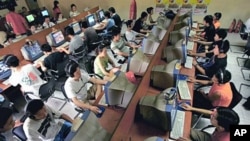
China's state news agency has called for a crackdown on what it calls the spread of toxic rumors over the Internet.
Xinhua published an article Tuesday in Chinese-only criticizing the increasingly popular social networking sites for spreading rumors like cancer, and urged preventive action.
Chinese authorities use sophisticated software to try to control what is said on the Internet. The government has become increasingly nervous about the Arab uprisings, which have gathered huge support through online networking. Officials fear they may inspire unrest in China.
Human rights groups say China is stifling free speech. Eric Harwit, an adjunct fellow at the East-West Center in Hawaii, tells VOA that Beijing also may be genuinely concerned about the spread of misinformation.
“In some cases, I think there are people who do want to incite action or opposition to the government and to propagate information that isn’t exactly correlated with reality,” he said. “The statement by the government may be rather strong and might stifle online discussion, but I think the government does sense that there are rumors that could be harmful to society and to stability.”
Most recently, users of China's Weibo service, the country's equivalent of Twitter, sent millions of messages criticizing the official response to the high-speed train disaster in July, which killed 40 people. Harwit said that event prompted the government not just to clamp down on information, but to release it, as well.
“I think the train crash issue certainly was one that the government saw as inspiring the government to release more information on an important event, and probably did involve some people in society spreading information that wasn’t necessarily accurate,” he said.
Despite Beijing’s warning, Harwit said he does not believe China’s “microblogs” are going away. Microblogs are Web sites that allow people to post short updates in real-time. Popular topics include news, entertainment and financial advice.
“They’ve become too popular. The companies that are the main providers of microblogs, Sina and Tencent, they’ve been promoting the use of these microblogs for the last few years. So it’d be very difficult for the government to tell them to stop.”
China has the world's largest online population, with close to 500 million users.