


China is calling for an inclusive political transitional process in Libya, as soon as possible, following the death of former leader Moammar Gadhafi.
Foreign Ministry spokeswoman Jiang Yu said China hopes Libya can launch a transitional political process that includes all parties and viewpoints.
Jiang says China hopes the political process will accommodate the concerns of different factions, and that the country can realize reconciliation and reunification.
In the decades that Gadhafi controlled Libya, China had very good relations with him.
The Chinese spokeswoman had no direct answer to a question about whether Beijing's attitude toward the former Libyan leader had changed in recent months.
She said China and Libya have had what she describes as “normal relations” based on mutual respect, equality and mutual benefit.
She says Beijing respects the choice of the Libyan people, and believes that relations with Libya will forge ahead in a stable and smooth manner.
She also had no direct answer to a question about whether China has been in contact with Libya's National Transitional Council leaders after Gadhafi's death Thursday. Instead, she said only that the Chinese embassy in Libya has had what she described as “smooth” channels of communication.
China last month was the last of the five permanent members of the United Nations Security Council to recognize the National Transitional Council as Libya's legitimate government.
NTC members had previously warned Beijing that its $18 billion worth of investments and contracts in Libya could be at risk because it had been slow to support the revolt against Gadhafi. China abstained on a U.N. Security Council vote in March to authorize the use of force to protect Libyan civilians from Gadhafi's forces, and was sharply critical of the NATO-assisted mission there.
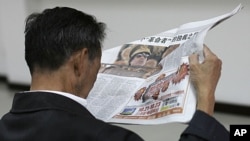
Chinese media reports were devoid Friday of any of this past criticism and instead referred disparagingly to Gadhafi as a “madman.”
There was some sympathy for the former Libyan leader on Chinese Internet chat sites. One user called him a friend of the Chinese people, while another user described him as a “heroic warrior against Western imperialism,” who was “slain by Western bullets wielded by his own people.”
China Calls For Speedy, Inclusive Political Transition in Libya