


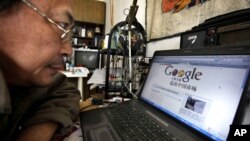
Analysts say China's new Communist Party leaders are giving no indication they intend to relax the country's tough online censorship laws.
Many had hoped China's once-a-decade leadership transition, which began last month with the 18th Party Congress, would bring at least a small degree of relief for the country's estimated 500 million web users.
But in recent weeks Beijing has seemingly taken steps to reinforce the so-called "Great Firewall of China" that largely separates the country's online population - by far the world's largest - from the rest of the global Internet.
Crackdown on VPN usage
VOA reported last week that many foreign virtual private network (VPN) providers, which enable Internet users to get around censorship restrictions, have complained their servers are being blocked in China because of apparent changes in the firewall.
State media suggested the issue was because many VPN providers had failed to register with the government, and therefore were not protected by Chinese laws.
A widespread crackdown on VPN usage could be devastating for foreigners doing business in China, since many use the technology to access the government's ever-expanding list of blocked websites, which includes Facebook, Twitter, and YouTube.
Changes in censorship policy superficial
Following the Congress, hopes of censorship reform in social media were raised temporarily when authorities appeared to allow more open discussion on the country's microblogs.
China's biggest microblog, the wildly popular Sina Weibo, began allowing users to search for the names of top government leaders that had long been blocked.
Authorities also took steps to allow greater criticism of lower-level government corruption, resulting in investigations that led to the dismissal of several officials.
But observers say both improvements are superficial. Michael Anti, a prominent journalist and commentator on Chinese social media, tells VOA that public criticism of China's rampant government corruption is not a new development.
"CCTV, the national TV station, has already had the function of criticizing and monitoring local corruption since the 1990s. Now they're repeating the same thing on Weibo," he says. "I don't regard this as progress. It just proves Weibo is now becoming a part of central media."
He points out that public discussion about China's top leaders is still tightly monitored by Weibo's massive team of censors, which - implicitly or explicitly - follows orders from Beijing to filter out any material deemed a threat to the party.
Government hints at further restrictions
Some even fear a heightened Internet crackdown, after state media published a wave of recent editorials defending government censorship.
The Communist Party's Global Times said Friday the government's management over the Internet has been "moderate so far," and called for authorities to "strengthen regulations."
A series of apparently leaked government directives, published by the China Digital Times, orders central media outlets to prominently report on the dangers of the Internet and the punishment of online criminals.
Jeremy Goldkorn, director of Danwei.com, a site about the Chinese media and Internet, said in an interview with VOA that he doesn't foresee many changes, in either direction.
"I just don't see that there's going to be any change. I don't see anybody in the government who's committed to liberalization of Internet policy or media policy," says Goldkorn. "But will it get much worse? That's always a possibility."
Anti also takes a pessimistic stance, warning against anyone who thinks a new era of Internet freedom is about to unfold.
"Definitely not, because censorship is crucial for the party's rule," he says. "The party's rule is very centralized. The Internet by nature is very de-centralized. It doesn't match. Censorship is the only way to fix the Internet's side effects."
Many had hoped China's once-a-decade leadership transition, which began last month with the 18th Party Congress, would bring at least a small degree of relief for the country's estimated 500 million web users.
But in recent weeks Beijing has seemingly taken steps to reinforce the so-called "Great Firewall of China" that largely separates the country's online population - by far the world's largest - from the rest of the global Internet.
Crackdown on VPN usage
VOA reported last week that many foreign virtual private network (VPN) providers, which enable Internet users to get around censorship restrictions, have complained their servers are being blocked in China because of apparent changes in the firewall.
State media suggested the issue was because many VPN providers had failed to register with the government, and therefore were not protected by Chinese laws.
A widespread crackdown on VPN usage could be devastating for foreigners doing business in China, since many use the technology to access the government's ever-expanding list of blocked websites, which includes Facebook, Twitter, and YouTube.
Changes in censorship policy superficial
Following the Congress, hopes of censorship reform in social media were raised temporarily when authorities appeared to allow more open discussion on the country's microblogs.
China's biggest microblog, the wildly popular Sina Weibo, began allowing users to search for the names of top government leaders that had long been blocked.
Authorities also took steps to allow greater criticism of lower-level government corruption, resulting in investigations that led to the dismissal of several officials.
But observers say both improvements are superficial. Michael Anti, a prominent journalist and commentator on Chinese social media, tells VOA that public criticism of China's rampant government corruption is not a new development.
"CCTV, the national TV station, has already had the function of criticizing and monitoring local corruption since the 1990s. Now they're repeating the same thing on Weibo," he says. "I don't regard this as progress. It just proves Weibo is now becoming a part of central media."
He points out that public discussion about China's top leaders is still tightly monitored by Weibo's massive team of censors, which - implicitly or explicitly - follows orders from Beijing to filter out any material deemed a threat to the party.
Government hints at further restrictions
Some even fear a heightened Internet crackdown, after state media published a wave of recent editorials defending government censorship.
The Communist Party's Global Times said Friday the government's management over the Internet has been "moderate so far," and called for authorities to "strengthen regulations."
A series of apparently leaked government directives, published by the China Digital Times, orders central media outlets to prominently report on the dangers of the Internet and the punishment of online criminals.
Jeremy Goldkorn, director of Danwei.com, a site about the Chinese media and Internet, said in an interview with VOA that he doesn't foresee many changes, in either direction.
"I just don't see that there's going to be any change. I don't see anybody in the government who's committed to liberalization of Internet policy or media policy," says Goldkorn. "But will it get much worse? That's always a possibility."
Anti also takes a pessimistic stance, warning against anyone who thinks a new era of Internet freedom is about to unfold.
"Definitely not, because censorship is crucial for the party's rule," he says. "The party's rule is very centralized. The Internet by nature is very de-centralized. It doesn't match. Censorship is the only way to fix the Internet's side effects."