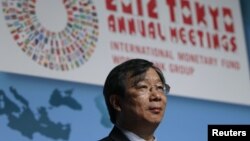
TOKYO – China's central bankers on Sunday allowed some public and direct insight into their thinking. A top official of the People's Bank of China delivered remarks to those who had been attending a joint meeting of the International Monetary Fund and World Bank in Tokyo.
The deputy governor of the People's Bank of China, Yi Gang, says the priority for monetary authorities in Beijing is on stable prices and they want to pursue a sustainable path of economic development.
China's next stimulus package - focused on expanding the country's transportation infrastructure, will be an appropriate one, according to Yi.
"When I say appropriate in terms of size that is large enough to stabilize the growth but not too large to cause some further negative impact or negative problem in the future."
China's economy has slowed for the past six consecutive quarters. But it still has cash reserves estimated to be around 40 percent of its gross domestic product and with official foreign currency reserves around three-and-a-quarter trillion dollars.
Yi, speaking for his boss, characterized the Chinese currency as having reached its equilibrium, and said the central bank had not intervened in the foreign exchange market in the past year.
The United States has long urged Beijing to lift exchange markets controls, contending the Chinese currency is undervalued and that gives China's exports an unfair price advantage overseas.
Yi said the central bank will continue to diversify its reserve holdings as China is already sitting on enough cash, and "in terms of reserves, it's not the more the better."
The central bank number two told the audience of banking officials that he does not promote the internationalization of the renminbi (the official name for the yuan) and moves in that direction are totally market-driven.
Responding to a question about what authorities will do amid speculation China faces a bubble with soaring urban real estate prices, especially in Beijing and Shanghai, Yi indicated he and fellow central bankers are keeping a close watch.
"Right now whether it's a correct level or it's a bubble is not known. But if it continues to go up the probability is higher and higher it will become a bubble. Right? So, that we certainly don't want to have a bubble so we want to stabilize the real estate prices."
Yi was a stand-in at the Tokyo meetings for the People's Bank of China governor Zhou Xiachuan and delivered a speech on his behalf.
Zhou, along with China's finance minister, broke with their country's own protocol and did not send top relevant officials to the annual event.
Chinese officials have made no secret this was meant to express Beijing's displeasure over a recently re-ignited territorial dispute with Japan.
The deputy governor of the People's Bank of China, Yi Gang, says the priority for monetary authorities in Beijing is on stable prices and they want to pursue a sustainable path of economic development.
China's next stimulus package - focused on expanding the country's transportation infrastructure, will be an appropriate one, according to Yi.
"When I say appropriate in terms of size that is large enough to stabilize the growth but not too large to cause some further negative impact or negative problem in the future."
China's economy has slowed for the past six consecutive quarters. But it still has cash reserves estimated to be around 40 percent of its gross domestic product and with official foreign currency reserves around three-and-a-quarter trillion dollars.
Yi, speaking for his boss, characterized the Chinese currency as having reached its equilibrium, and said the central bank had not intervened in the foreign exchange market in the past year.
The United States has long urged Beijing to lift exchange markets controls, contending the Chinese currency is undervalued and that gives China's exports an unfair price advantage overseas.
Yi said the central bank will continue to diversify its reserve holdings as China is already sitting on enough cash, and "in terms of reserves, it's not the more the better."
The central bank number two told the audience of banking officials that he does not promote the internationalization of the renminbi (the official name for the yuan) and moves in that direction are totally market-driven.
Responding to a question about what authorities will do amid speculation China faces a bubble with soaring urban real estate prices, especially in Beijing and Shanghai, Yi indicated he and fellow central bankers are keeping a close watch.
"Right now whether it's a correct level or it's a bubble is not known. But if it continues to go up the probability is higher and higher it will become a bubble. Right? So, that we certainly don't want to have a bubble so we want to stabilize the real estate prices."
Yi was a stand-in at the Tokyo meetings for the People's Bank of China governor Zhou Xiachuan and delivered a speech on his behalf.
Zhou, along with China's finance minister, broke with their country's own protocol and did not send top relevant officials to the annual event.
Chinese officials have made no secret this was meant to express Beijing's displeasure over a recently re-ignited territorial dispute with Japan.