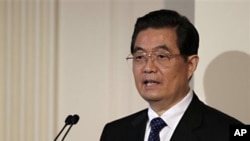
China is calling President Hu Jintao’s talks with President Barack Obama successful, and says the two leaders reached "important consensus” on a wide range of issues.
Chinese newspapers Thursday carried front page pictures of President Hu with President Obama at the White House. Headlines cheered a new chapter in relations between the two countries and reports accentuated the positive news from the meeting.
An English dispatch from the official Xinhua news agency characterized Mr. Hu’s visit to Washington as "a historic masterstroke of China-U.S. diplomacy"”
Foreign Ministry spokesman Hong Lei echoed that upbeat tone.
Hong says President Hu had successful talks with President Obama. He says the two sides agreed to work on building a Sino-American partnership of mutual benefit and mutual respect - which he called the "trend of the times"”
He said the two sides reached "important consensus" on many issues, including military relations, North Korea, Iran, Sudan, space, technology and high-level exchanges. He did not go into detail on the issues.
The spokesman said the two sides also stressed the importance of Taiwan.
Hong says Mr. Hu stressed that the Taiwan issue concerns China’s sovereignty and territorial integrity, and so hopes the United States abide by relevant commitments, as well as appreciate and support China’s position.
Beijing considers Taiwan part of its territory, and has not renounced the use of force to reunify the separately governed island if it declares independence.
The United States recognizes only one China, but is committed to helping Taiwan defend itself and angers China by selling arms to the island.
The Chinese spokesman repeated President Hu’s comments on human rights. He acknowledged that China and the United States have serious differences” on human rights, but that both countries are constantly improving.
Despite the Chinese government’s candor over human rights, censors in the country apparently remain nervous about the issue being mentioned publicly. International television news reports on Mr. Hu’s trip were blacked out as soon as human rights were mentioned.
China Declares Hu, Obama Meetings Successful