



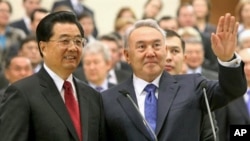
The vendor is Chinese, the products are Chinese, but the market is here in Almaty, capital of Kazakhstan, the most prosperous of Central Asia's five "stans," or former Soviet Republics
In Baraholka, the city's largest bazaar, vendors offer blue jeans, humidifiers, mobile phone chargers, and fresh apples - all from China. The trading language is still largely Russian, a legacy of the old colonial power. But as Alira, a vendor here, says, the products are not.
"Russian products? We have no Russian products," Alira says adamantly.
China is doing more than selling pots and pans to Central Asia's 62 million people. A thirst for energy is behind China's massive oil and gas investments in Central Asia, long the privileged sphere of Russia.
Chinese demand for energy edges U.S.
The International Energy Agency reports China is displacing the United States this year as the world's-largest energy consumer. Over the next 25 years, China's energy consumption is expected to double.
But the bulk of China's imported oil and gas passes through vulnerable sea lanes. Hongyi Lai, a professor at the University of Nottingham, studies China's global search for energy.
"The importance of Central Asia for China is in terms of energy security," says Lai. "It provides transport of oil and gas overland, not through sea lanes. So in this form, it is more secure for China."
Central Asia has some of the world's largest reserves of oil and gas. Once a dusty stretch of the Silk Road for camel caravans taking Chinese products to Europe, Central Asia is now a destination for Chinese investment - about $25 billion at last count.
New infrastructure
Last year saw the openings of the first pipelines carrying Central Asian oil and gas east to China. Now Turkmen gas heats apartment buildings in Beijing.
Almost overnight, Turkmenistan, which holds the fourth-largest gas reserves in the world, is selling more gas to China than to Russia. Kazakhstan, which plans to be among the world's top 10 oil producers, now sells one quarter of its oil to China.
In addition to paying for pipeline expansions, China is paying for a 3,000-kilometer highway across Kazakhstan that is to be part of a new, asphalt Silk Road, allowing trucks to drive from China to Western Europe.
Fading Russian legacy
American author Parag Khanna, says in his new book, "How to Run the World," that these new pipelines, highways and railroads radiate out of China into Central Asia, "like five fingers on a hand." This puts Russia on the defensive in Central Asia, long its privileged sphere of influence.
"Russia, if it wants to remain relevant, is going to have to be putting its money where its mouth is, and buying into these kinds of deals as well," Khanna points out. "It has a very strong legacy position in electricity and energy and other sorts of sectors in the former Soviet Republics in Central Asia, but it needs to defend that turf more actively, particularly given the generational change, linguistic change, western orientation, as well as eastern orientation, among the next generation of leadership in all of those countries. It really cannot take anything for granted," he says.
With daily flights between Almaty and Urumqui, China's nearest regional capital, a generation of Central Asians is growing up with no memories of the Soviet-Chinese confrontation that kept the border frozen shut for most of the 20th century.
Kazakh political scientist Dosym Satpayev watches the surge of young Kazkakhs studying Chinese and winning scholarships to study in China.
"A lot of young people receive education in China and when they will return to our countries, maybe China will use these people as [a] lobby to realize their own interests, not only in economic sphere, but in culture sphere, in informational sphere," Satpayev says. "As for Russia, I believe this country will decrease position in our region because Russia is not a very strong competitor.''
Kazakhs now say, in Russian: 'If you want to leave, study English. If you want to stay, study Chinese."
Some unease with new order
But a backlash may be brewing. Kazakh authorities dropped a plan to rent one-million hectares of unused farmland to Chinese farmers.
Aidos Sarym, who runs an opposition research organization in Almaty, says many Kazakhs are uneasy about the Chinese giant. Kazakhs worry about their eastern neighbor with a population 100 times that of Kazakhstan, says Sarym.
But China's rapid economic thrust may now be irreversible. An American-trained Kazakh businessman, Baurzhon Doszhanov, looks around Baraholka bazaar as he shops for a Chinese-made camping lantern.
"If we remove Chinese stuff, we will be naked, " says Doszhanov.