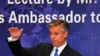



China's new Ambassador to the United Nations in Geneva says his country does not want Iran to have nuclear weapons. But he says his country is opposed to sanctions against Iran, calling them counterproductive.
In his first news conference since assuming his post as Permanent Representative to the United Nations, Chinese Ambassador He Yafei tells journalists in Geneva his country does not want Iran to become a member of the nuclear-weapons club.
He notes Iran is a member of the Nuclear Non-proliferation Treaty and, as such, he says it is entitled to develop nuclear energy for peaceful purposes.
"But, Iran should not develop any capability that can produce nuclear weapons. That would be very de-stabilizing and that would be against NPT [non-proliferation treaty] regime. China is very much for safeguarding and strengthening the nuclear non-proliferation regime," he said.
Ambassador He says China is opposed to imposing sanctions against countries in general and against Iran in particular. He says sanctions usually do not work because they target ordinary people, who are the ones who suffer.
The United States and other Western powers accuse Iran of secretly working to develop nuclear weapons, a charge Teheran refutes. Iran says it is developing nuclear energy for peaceful purposes.
Iran has backtracked on a deal with the West to exchange low-enriched uranium for higher-grade fuel that can be used in a reactor producing medical isotopes. This has particularly angered the United States, which is threatening to push for United Nations sanctions against Iran.
Chinese Ambassador He opposes going down this road. He says China does not think sanctions will work and urges dialogue as a better way to go.
"I think the door of compromise through negotiations, the door of diplomacy is not closed, is not closed. We need to do our best and we need to exhaust every avenue before we decide on whether we should have new additional sanction measures," the ambassador said.
On another issue, the ambassador rejects Washington's criticism that China is intentionally keeping the value of its currency, the Yuan, artificially low to boost its exports.
Trade tensions between the United States and China have been rising. And, many U.S. lawmakers are calling for stiff tariffs on Chinese goods. Ambassador He accuses Congress of using China as a scapegoat to explain its own economic failures.