China's territorial dispute with Japan over a group of islands in the East China Sea is also testing the country's relations with the U.S.
While both the American and the Chinese governments are taking steps to avoid escalating tensions between Asia's two biggest economies, there were signs this week that Washington’s alliance with Japan and its intentions in the region remain a source of friction.
During a visit to China this week, U.S. Defense Secretary Leon Panetta urged China and Japan to exercise restraint and repeated Washington's insistence that it does not take sides in the dispute. But an article in China's state-run Global Times said it is "obvious" that Washington is partial to Japan.
Shi Yinhong, professor of international relations at Beijing’s Renmin University says that China is suspicious of Japan’s military alliance with the United States, guaranteed by the Japan-U.S. security treaty of 1951. The pact assures that Japan gets U.S. assistance should China take military action against its neighbor.
“The Chinese government views the U.S. as encouraging illegal actions by Japan. The government is dissatisfied with this, and the Chinese population is even more dissatisfied,” Shi says.
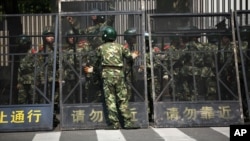
Anti-Japanese rallies started in China after Japan announced it would nationalize three disputed islands in the East China Sea, known as Senkaku in Japan and Diaoyu in China.
Some slogans during the most recent marches criticized the United States, blamed by people for having included the disputed islets into its security treaty with Japan.
On Tuesday, the U.S. ambassador’s car was surrounded in Beijing by a small group of protesters who had wandered away from the nearby Japanese embassy, focal point of the recent demonstrations. Protesters pelted the car with small objects before Chinese police intervened and the car was able to make its way inside the diplomatic compound.
“I believe that this event will push the Chinese government to be more serious and more insistent to ensure that anti-Japanese protests are conducted in accordance with the law,” Shi Yinhong says.
Renown artist and Chinese government critic Ai Weiwei, who posted a video showing ambassador Gary Locke’s car becoming target of the protesters, told the French News agency that he believes central authorities were encouraging mass rallies.
Although extreme anger against Japan was palpable at the marches and some slogans included calls for brutal retaliation measures against China’s long time rival, most of the protests were peaceful. Reports of violence against Japanese individuals and businesses in some Chinese cities including Shenzhen and Guangzhou prompted the Chinese Foreign Ministry to say that criminal episodes would be investigated according to the law.
David Zweig, professor of social science at Hong Kong’s University of Science and Technology, says that Beijing certainly wished the demonstrations did not turn violent, but was in careful in how it phrased its warning.
“They did not publicly condemn the use of violence because that might make them look like they don’t support the marches or the protests,” Zweig says. “It’s a way of warning people, without antagonizing them,” he adds.
With no more protests reported since Tuesday and after a three-day visit by the American defense secretary, Zweig believes that China and the U.S. now have some breathing space to move forward in their overall relations.
“They decided to have joint exercises, which is a significant move forward,” he says.
Yet next month both countries face an uncertain political phase, with an election in the United States and China’s Party Congress expected to nominate the country’s next rulers.
Shi Yinhong says that this might complicate the two country’s traditional rivalries, which he thinks have gotten worse in the last few years and during the recent crisis with Japan.
While both the American and the Chinese governments are taking steps to avoid escalating tensions between Asia's two biggest economies, there were signs this week that Washington’s alliance with Japan and its intentions in the region remain a source of friction.
During a visit to China this week, U.S. Defense Secretary Leon Panetta urged China and Japan to exercise restraint and repeated Washington's insistence that it does not take sides in the dispute. But an article in China's state-run Global Times said it is "obvious" that Washington is partial to Japan.
Shi Yinhong, professor of international relations at Beijing’s Renmin University says that China is suspicious of Japan’s military alliance with the United States, guaranteed by the Japan-U.S. security treaty of 1951. The pact assures that Japan gets U.S. assistance should China take military action against its neighbor.
“The Chinese government views the U.S. as encouraging illegal actions by Japan. The government is dissatisfied with this, and the Chinese population is even more dissatisfied,” Shi says.
Anti-Japanese rallies started in China after Japan announced it would nationalize three disputed islands in the East China Sea, known as Senkaku in Japan and Diaoyu in China.
Some slogans during the most recent marches criticized the United States, blamed by people for having included the disputed islets into its security treaty with Japan.
On Tuesday, the U.S. ambassador’s car was surrounded in Beijing by a small group of protesters who had wandered away from the nearby Japanese embassy, focal point of the recent demonstrations. Protesters pelted the car with small objects before Chinese police intervened and the car was able to make its way inside the diplomatic compound.
“I believe that this event will push the Chinese government to be more serious and more insistent to ensure that anti-Japanese protests are conducted in accordance with the law,” Shi Yinhong says.
Renown artist and Chinese government critic Ai Weiwei, who posted a video showing ambassador Gary Locke’s car becoming target of the protesters, told the French News agency that he believes central authorities were encouraging mass rallies.
Although extreme anger against Japan was palpable at the marches and some slogans included calls for brutal retaliation measures against China’s long time rival, most of the protests were peaceful. Reports of violence against Japanese individuals and businesses in some Chinese cities including Shenzhen and Guangzhou prompted the Chinese Foreign Ministry to say that criminal episodes would be investigated according to the law.
David Zweig, professor of social science at Hong Kong’s University of Science and Technology, says that Beijing certainly wished the demonstrations did not turn violent, but was in careful in how it phrased its warning.
“They did not publicly condemn the use of violence because that might make them look like they don’t support the marches or the protests,” Zweig says. “It’s a way of warning people, without antagonizing them,” he adds.
With no more protests reported since Tuesday and after a three-day visit by the American defense secretary, Zweig believes that China and the U.S. now have some breathing space to move forward in their overall relations.
“They decided to have joint exercises, which is a significant move forward,” he says.
Yet next month both countries face an uncertain political phase, with an election in the United States and China’s Party Congress expected to nominate the country’s next rulers.
Shi Yinhong says that this might complicate the two country’s traditional rivalries, which he thinks have gotten worse in the last few years and during the recent crisis with Japan.