China Minister Tells UN Japan 'Stole' Disputed Islands
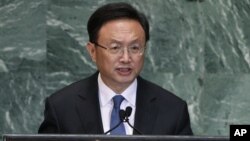
Chinese Foreign Minister Yang Jiechi addresses the 67th session of the United Nations General Assembly, September 27, 2012.
China's foreign minister says Japan's recent purchase of disputed islands in the East China Sea is "illegal and invalid" and that the move does not affect Beijing's historical claim to the rocky archipelago.
In a speech late Thursday to the United Nations General Assembly, Yang Jiechi said the Japanese purchase "grossly violated" Chinese sovereignty. Yang said it cannot change the "historical fact that Japan stole" the islands from China.
Japan purchased some of the islands from their private Japanese landowner earlier this month. Though Tokyo said it was meant to help manage the dispute, the move infuriated Beijing and prompted violent anti-Japan across China.
U.S. Secretary of State Hillary Clinton met with Foreign Minister Yang on Thursday. In the meeting, she called for "cooler heads to prevail" and for the dispute to be solved peacefully.
State Department officials say Clinton also stressed that stability in Asia is vital for the struggling world economy.
But there were no immediate signs that either side would back down from their positions in the simmering dispute, which has brought Japan-China relations to their lowest point in years.
In Yang's address to the U.N., he repeated Beijing's stance that the islands have been part of Chinese territory since ancient times. Yang said the islands were seized by Japan after it won the Sino-Japanese War in 1895.
On Wednesday, Japanese Prime Minister Yoshihiko Noda vowed that Tokyo will not compromise on its claim to the islands, which he called an "inherent part" of Japan's territory.
Both sides have continued to hold high-level talks in hopes of resolving the dispute diplomatically, but officials have described the atmosphere as "tense" and "severe."
There are concerns that the dispute over islands may hurt the strong economic relationship between China and Japan, Asia's two largest economies.
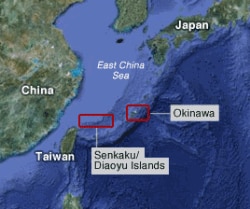
The islands, known as Senkaku in Japan but Diaoyu in China, are surrounded by rich fishing grounds and potential oil reserves.
The Voice of America provides news and information in more than 40 languages to an estimated weekly audience of over 326 million people. Stories with the VOA News byline are the work of multiple VOA journalists and may contain information from wire service reports.