



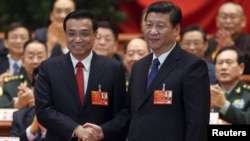
China's parliament has elected Li Keqiang premier as the country's Communist Party nears the final stages of its once-a-decade transition of power.
As expected, the National People's Congress on Friday nearly unanimously selected the English-speaking Mr. Li to replace Wen Jiabao. The 57-year-old will be in charge of running China's economy and day-to-day leadership of the government.
The parliament, which reflexively endorses the decisions of the Communist Party, named Xi Jinping as president a day earlier, in a formality that completes his rise to China's top leadership position.
Since attaining the top spots in the party at a congress in November, the two men have vowed to revamp China's economy, reduce pollution and crack down on widespread corruption. They are expected to serve in their positions for the next 10 years.
Cabinet appointments and other top government positions will be announced Saturday, providing more insight into the direction of China's new leaders. Observers will also look for clues when Mr. Li holds a rare news conference at the end of the National People's Congress on Sunday.
Douglas Paal with the Carnegie Endowment for International Peace says he expects the new leadership will try to take advantage of the reputation of its predecessors for having been slow to reform and not strong enough abroad.
"We see a strong emphasis coming out of the party at the [National People's Congress] and other meetings of the last two weeks to convey a sense that reform is going to move forward in the next five years, and we also see a strong sense of continuity in foreign policy," he said.
Paal says he expects China's new leaders to continue protecting China's interests in the conflicts that have developed with some of its neighbors, including territorial disputes with Japan and the Philippines.
U.S. President Barack Obama discussed foreign policy with President Xi during a Thursday phone call to congratulate the leader on his new position. The White House says the discussion focused in part on the North Korean nuclear threat and the growing concern of cyber security - both issues that have tested Washington's relationship with Beijing.
Kerry Brown, executive director of the University of Sydney's China Studies Center, says that Xi knows one of his biggest tasks as president will be to look after China's complicated relationship with America.
"And thankfully there's not at the moment a big issue between them, like arms sales to Taiwan or issues about Tibet or some big, big kind of problem." said Brown.
Leaders of both countries will get a chance to discuss matters of mutual interest next week, when U.S. Treasury Secretary Jacob Lew heads to China for talks. Secretary of State John Kerry will also visit Beijing in the coming weeks.
As expected, the National People's Congress on Friday nearly unanimously selected the English-speaking Mr. Li to replace Wen Jiabao. The 57-year-old will be in charge of running China's economy and day-to-day leadership of the government.
The parliament, which reflexively endorses the decisions of the Communist Party, named Xi Jinping as president a day earlier, in a formality that completes his rise to China's top leadership position.
Since attaining the top spots in the party at a congress in November, the two men have vowed to revamp China's economy, reduce pollution and crack down on widespread corruption. They are expected to serve in their positions for the next 10 years.
Cabinet appointments and other top government positions will be announced Saturday, providing more insight into the direction of China's new leaders. Observers will also look for clues when Mr. Li holds a rare news conference at the end of the National People's Congress on Sunday.
Douglas Paal with the Carnegie Endowment for International Peace says he expects the new leadership will try to take advantage of the reputation of its predecessors for having been slow to reform and not strong enough abroad.
"We see a strong emphasis coming out of the party at the [National People's Congress] and other meetings of the last two weeks to convey a sense that reform is going to move forward in the next five years, and we also see a strong sense of continuity in foreign policy," he said.
Paal says he expects China's new leaders to continue protecting China's interests in the conflicts that have developed with some of its neighbors, including territorial disputes with Japan and the Philippines.
U.S. President Barack Obama discussed foreign policy with President Xi during a Thursday phone call to congratulate the leader on his new position. The White House says the discussion focused in part on the North Korean nuclear threat and the growing concern of cyber security - both issues that have tested Washington's relationship with Beijing.
Kerry Brown, executive director of the University of Sydney's China Studies Center, says that Xi knows one of his biggest tasks as president will be to look after China's complicated relationship with America.
"And thankfully there's not at the moment a big issue between them, like arms sales to Taiwan or issues about Tibet or some big, big kind of problem." said Brown.
Leaders of both countries will get a chance to discuss matters of mutual interest next week, when U.S. Treasury Secretary Jacob Lew heads to China for talks. Secretary of State John Kerry will also visit Beijing in the coming weeks.