News / Asia

Pollution in China Goes 'Off the Charts'

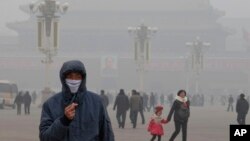
A man wears a mask on Tiananmen Square in thick haze in Beijing Tuesday, Jan. 29, 2013. Extremely high pollution levels shrouded eastern China for the second time in about two weeks.  (AP Photo/Ng Han Guan)
A man wears a mask on Tiananmen Square in thick haze in Beijing Tuesday, Jan. 29, 2013. Extremely high pollution levels shrouded eastern China for the second time in about two weeks. (AP Photo/Ng Han Guan)
TEXT SIZE - +
The stifling pollution currently plaguing much of northeastern China has reached levels so high it is beyond the measurements used in the U.S. to chart air quality.

“What Beijing is experiencing–and even worse in the provinces–is off the charts from anything we experience in the United States, and likely more than anything we’ve experienced in our country’s history,” said John Walke, the director of the Climate & Clean Air Program at the Natural Resources Defense Council, a Washington, D.C.-based environmental group.

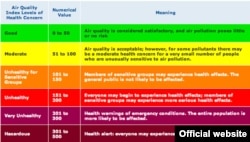
The U.S. measures air quality using a six-color scale indexed from 0-500. The higher the number, the greater and more dangerous the pollution. According to the Environmental Protection Agency, 50 would represent good–or "code green"–air quality, while anything over 300 represents hazardous–or "code maroon"–air quality. 

The Environmental Protection Agency's air quality guide.The Environmental Protection Agency's air quality guide.
x
The Environmental Protection Agency's air quality guide.
In the summer in Washington, D.C., for example, there may be several days during which pollution reaches 101-150. These are called “code orange” days, meaning the air is deemed unsafe for children and the elderly.

The next level, “code red,” goes from 151-200. Washington may experience a couple of these days in a summer, while a city notorious for poor quality air such as Los Angeles may have a dozen or so, according to Walke.

“The scale above 200 is so rare that we virtually never experience it,” said Walke. “It is deemed very unhealthy.”

Above 200 would be “code purple,” with pollution measuring 201-300; from 301-500 is called “code maroon.” These levels are only seen in the vicinity of large forest fires, Walke said.
 
On Tuesday, pollution in Beijing reached 517, a number that is considered “beyond index.”
 
This is according to the U.S. Embassy in Beijing, which is considered the most reliable measurement of air pollution in the city. The embassy has reported pollution as high as 755 earlier this month.

Unsustainable

Higher air quality numbers indicate the presence of more small particles in the air, and Walke explained it’s the smallest particles, the 2.5 micrometer-sized pollution particles, that present the most danger.

“The particles are so small that they can penetrate into the heart, lungs and bloodstream,” he said. “They bypass the body’s natural defense systems and are linked to health ailments like heart attacks, strokes, bronchitis and asthma, chiefly among the elderly.”

According to Dominic Meagher, an economist with China Policy Institute in Beijing, the air quality levels have been hovering around 490 over the past two weeks.

“490 is very hazardous,” he said. “Children are kept indoors, elderly are kept indoors, and healthy people are recommended not to do any physical exercise. It’s not very pleasant.”
 
The smog was so bad in Zheijiang province that when a furniture factory caught fire earlier this month, the blaze burned for three hours before anyone noticed the smoke.

Indiana University professor Scott Kennedy reported from downtown Beijing that the smog was so bad he could not see the top of the tallest building in the city, the 300-meter World Trade Center Tower III.  He added that he could only see about a block and a half down the street.

The Chinese government has shut down over 100 polluting factories and taken a third of all government vehicles off the road, but pollution in Beijing has remained at dangerous levels.  According to Meagher, these kinds of temporary, “heavy-fisted” regulations are not a sustainable solution.  He said the government is going to have to consider longer and perhaps mandatory regulations to deal with a problem that is very much in the public eye.

“What they’re going to need to do is have a very frank debate about what their options are,” he said. “I imagine it’s going to include strict enforcement of standards on vehicles and factories.”

Meagher also said it would be crucial to get energy companies to increase efficiency standards, something he said they have been reluctant to do.

VOA's Victor Beattie contributed to this report.

You May Like

Experts Weigh In on Challenges of Closing Guantanamo Prison

Former chief military prosecutor at Guantanamo delivers petition to White House with more than 370,000 signatures, demanding facility be closed down immediately More

Karzai to Discuss Enhancing Defense Ties with India

Afghanistan looking for more military aid as it prepares for withdrawal of NATO forces by next year More

India, China Pledge to Overcome Border Tensions

Indian prime minister and Chinese premier attempt to move past tense standoff in the Himalayas during Delhi talks More

Burmese President Opens US Visit with VOA Town Hall Meeting

Ahead of his meeting with President Obama Monday, Thein Sein answered questions on human rights and economic development in his country More

This forum has been closed.
Comment Sorting
Comments
     
by: thoriel th
January 31, 2013 7:00 PM
China has transformed itself into a smoky hell! all folks living here will all face death caused by lung failure, and all pollution-related diseases! Mercury, Lead, Arsenic in the polluted air in China also are the silent killers!


by: Thoriel D. Thallermann
January 31, 2013 6:57 PM
China is a chimney of the world today! All Chinese Lungs are pollution filters of their emitted black smoke! 1.4 billions lungs of 1.4 billions Chinese will be used to filter air pollution for their industry!
Whan can you do is to see Chinese lungs are going to be THE BLACK LUNGS! The worst thing in life is to breethe contaminated air! And in this case, millions of Chinese will end up in death caused by polluted air! while water in China is almost all well contaminated! and contaminated water used to grow vegetable, fruits, roots, rice and they absolutely have become contaminated foodstuffs for consumers to consume and dying slowly as definitely can be proven by statistics!
In essence, the price that Chinese people have to pay is too high!


by: dorji from: oregon
January 30, 2013 9:31 PM
China is a complete joke. Here is a slogan for the chinese, "one world, one dream - die from lung cancer." Welcome to Beijing, baby!


by: Paris Tun from: Myanmar
January 30, 2013 4:44 AM
Needless to say that good air quality is vital for the survival of our humanity. If the Chinese couldn't fix this problem in time, they will be the first one to collapse, not Egypt or Syria. I wonder, the Chinese are feeling, like they are in a war zone because they couldn't even get their basis rights to breathe well.
It is time to think seriously about "Sustainable Development" and make sure that we truly know what it means. If we fail to do so, we will all be chocked to death by the pollution.


by: Craig D from: Chicago
January 30, 2013 12:38 AM
More coal plants anyone?


by: michael wind from: florida
January 29, 2013 7:01 PM
this pollution soon will be everywhere.

In Response

by: Sun from: Taipei
January 30, 2013 3:38 AM
Yes, this is another problem posed by Communist Chinese. They don't consider another person's concern. Let's wait until Chinese bubble economy collapses and then this kind of air pollution is stopped.

Featured Videos

Your JavaScript is turned off or you have an old version of Adobe's Flash Player. Get the latest Flash player.
Video

Video US Oil Surge Could Impact Mideast Geopolitics

The United States will account for a third of new oil supplies over the next five years, and will become energy self-sufficient in 20 years, according to a new report by the Paris-based International Energy Agency (IEA). Although U.S. oil imports from Arab Gulf countries increased last year, analysts predict the U.S. will lose its dependence on Middle East imports, which is expected to have a huge impact on international relations and the balance of power. VOA's Henry Ridgewell reports.