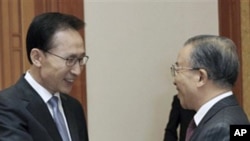



There has been no clear decision on China's proposal for new talks to defuse tensions on the Korean peninsula. Leaders met with several partners on how to best calm the situation following a North Korean attack on a South Korean community.
A day after China proposed multi-nation talks, its negotiating partners are still mulling the idea.
The South Korean government responded coolly to the Chinese proposal.
Rob Raines, a spokesman at the U.S. Embassy in Beijing, said Washington has not yet made a decision.
"The U.S. government is consulting with the Republic of Korea, Japan and our other partners. The six party talks cannot substitute for action by North Korea to comply with its obligations, " Raines said.
China wants to bring together the six countries that are already engaged in talks aimed at persuading Pyongyang to abandon its nuclear weapons programs - the United States, North Korea, China, South Korea, Japan and Russia.
China said the emergency session would focus on the current crisis brought about after North Korea fired on a South Korean island last week, and Seoul's forces fired back.
The embassy spokesman urged North Korea to fully abide by the armistice agreement that ended the Korean War in 1953. He also called on Pyongyang to comply with past agreements that promised aid to North Korea if it abandoned its nuclear weapons programs.
"Clear steps are needed by North Korea to demonstrate a change in its behavior," raines said.
The comments come as the U.S. and South Korea hold joint military exercises in the waters off South Korea. North Korea calls the exercises a sign of aggression.
The Chinese Foreign Ministry had no immediate comment Monday about other countries' lack of enthusiasm toward its proposal for talks.
Pang Zhongying, an international relations professor at Renmin University, said he suspects China already knew South Korea would not agree to the suggestion.
Pang thinks by making the proposal publicly, China is helping South Korea. He thinks South Korea wants to "make a U-turn," but cannot yet because too little time has passed since last week's incident.
He added that a multi-nation meeting could also be good for China's relationship with the United States.
Pang said if the meeting could happen soon, before Chinese President Hu Jintao goes to the United States in January, it would show good Sino-American cooperation.
China called for the meeting to take place in early December, but Pang thinks that may be too soon.
South Korea and the United States have long urged Beijing to do more to rein in its ally, North Korea. China's leaders, however, said they have done all they could to encourage Pyongyang to give up its nuclear weapons and that other nations must do more to calm tensions.
Many regional political analysts say Beijing is reluctant to push too hard on its impoverished neighbor, to avoid destabilizing the government and causing a massive flow of refugees.
China Quiet One Day After Proposing Talks on Korea Tensions