China Sends Ships to Stake Claim to Disputed Islands
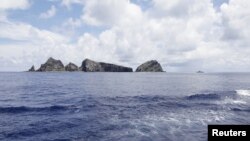
A group of disputed islands known as Senkaku in Japan and Diaoyu in China is seen from the city government of Tokyo's survey vessel in the East China Sea, September 2, 2012.
BEIJING — Tensions between China and Japan continued to rise Tuesday as Tokyo sealed a deal to purchase islands that Chinese authorities say belong to them.
China responded by sending two patrol ships to the hotly contested waters. According state-run Xinhua news agency, the two marine surveillance ships were deployed to assert what it called the country’s undisputed sovereignty in the area.
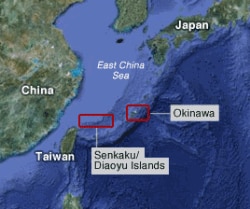
The islets, known in China as Diaoyu and in Japan as Senkaku, lie near strategic shipping and fishing grounds, as well as potential oil and gas reserves.
A commentary Tuesday in the official media outlet of China’s military, the PLA Daily, warned Japan that it was playing with fire. The commentary stressed that while the Chinese public yearned for peace, peace had to be built on mutual respect and not threaten China’s territorial integrity.
By moving its ships close to the disputed islands, China was trying to gain more leverage, said security analyst James Nolt, dean of the New York Institute of Technology’s Nanjing campus.
“I think they may be pushing towards some kind of settlement, and in order to get a settlement they want to be posturing in ways that might help them get a settlement that is more favorable to them,” Nolt said.
Chinese Foreign Ministry spokesman Hong Lei called Japan’s actions “completely illegal and invalid” and demanded that the country reverse its actions and return to the negotiating table.
China will take the necessary measures to maintain its territorial sovereignty, Hong Lei warned, but stopped short of saying what those measures might be.
In 2010, China temporarily halted shipments of rare earth elements to Japan during another standoff in the East China Sea. The minerals are crucial for manufacturing high tech products.
Wang Fan, a professor of International Relations at the China Foreign Affairs University in Beijing, said China will not hesitate to take economic actions to make its point.
While economic measures may hurt the Chinese economy as well, Wang said territorial issues are one of China’s core interests -- an area that Beijing will not compromise. If Japan continues on a confrontational path, military measures could not be ruled out, added Wang.
However, James Nolt said the possibility of actual armed conflict is out of the question for both countries, no matter how harsh their rhetoric might become.
“Japan is technologically superior and Japan's submarine force in particular is technologically very advanced," Nolt said. "Japan's air force is also technologically more advanced than China's. China tends to have numerical superiority, but because of the relatively limited range of most of China's aircraft, in an open sea conflict the numerical superiority of China would not come to bear very easily, so it is more likely that the advantages of both sides would cancel each other out.”
A military conflict in which no party involved has the upper hand would be devastating for both economies, Nolt added.
“Throughout East Asia economic health is so important that all parties have to be careful not to upset the prosperous relations that have made Asia the most fast growing region of the world. Any kind of armed military action could easily have a very, very negative impact on investment on consumer confidence on trade, on insurance rates," he said.
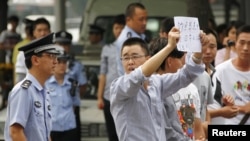
Demonstrators protest outside the Japanese embassy in Beijing on Sept. 11, 2012.
As diplomatic efforts to resolve the dispute continue, it was clear that angst over Japan’s decision was growing in China.
About a dozen protesters rallied outside the Japanese embassy in Beijing Tuesday, chanting “Japan, get out of China.”
China’s Xinhua news agency reported protests in several other cities on Tuesday, including a protest march of about 200 people in China’s northeastern province of Shandong.