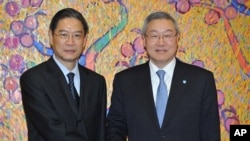
China and South Korea held strategy talks in what they promise will be increased communication aimed at ensuring the peninsula's stability. And two South Korean delegations have returned home after delivering personal condolences in Pyongyang to new North Korean leader Kim Jong Un for the death of his father Kim Jong Il.
China's vice foreign minister, Zhang Zhijun, was in the South Korean capital Tuesday for the first round of formal strategy talks between the two nations since the death of Kim Jong Il, leader of their mutual neighbor, North Korea.
South Korean First Vice Foreign Minister Park Suk-hwan called the talks meaningful and timely.
He says amid mounting concerns in the international community about the Korean peninsula's affairs, there had been a phone call between the foreign ministers of China and South Korea, and conversations have been taking place among the six-party talks countries.
Those six-party talks, which also include North Korea, Russia, the United States, and Japan, have been convening on and off for eight years in an attempt to persuade Pyongyang to end its nuclear weapons program.
Chinese Vice Foreign Minister Zhang says China and South Korea have been exchanging honest views about regional affairs for years, and he says he thinks that is very useful.
Moon Chung-in, a political science professor at Seoul's Yonsei University and frequent advisor to past governments, says the death of Kim Jong Il presents a unique "clear slate" opportunity in which the six-party nuclear talks may be able to restart. He says the North's new leader, Kim Jong Un, will need the talks if he is to win popular support by alleviating the country's severe poverty and malnutrition.
"Revitalization of the North Korean economy is virtually inconceivable with getting external support-- food aid, economic aid, and foreign direct investment," said Moon. "Without making substantial concessions on the nuclear weapons issue, he may not be able to get that kind of support from the outside. Even China will be reluctant."
China is the last of North Korea's historical allies. But some question Beijing's continuing willingness to back up Pyongyang, particularly in light of provocative actions such as the 2010 sinking of a South Korean naval vessel and the deadly shelling of a South Korean island the following year.
Lho Kyungsoo is a Seoul National University professor, and chairs the Asia Society Korea Center in Seoul. He says North Korea was useful to China during the Cold War and several decades thereafter, as a diplomatic bargaining chip with the United States. Now, however, he believes Beijing is undergoing a slow but sure change of heart.
"I think the majority of intelligent Chinese leaders increasingly see North Korea as a liability... They're growing unpredictable," he said. "And does China want to take responsibility on an international stage, for North Korea's actions? I think the cost to Beijing is growing."
Also Tuesday, two South Korean civilian delegations returned from North Korea after offering formal condolences at the hall where Kim Jong Il is lying in state. Lee Hee-ho, the widow of former South Korean President Kim Dae-jung, and Hyun Jeong-eun, wife of the former Hyundai group chairman who invested heavily in the North, were shown on North Korean television bowing and shaking hands with the country's new leader, Kim Jong Un.
Yoon Cheol-gu, spokesman for Lee Hee-ho, says there was not time for much dialogue.
He says having waited for some forty to fifty minutes, the ex-first lady was able to meet with Kim Jong Un for ten minutes. She expressed her condolences, and the North Korean successor thanked her for having made the long journey. There was unfortunately no time after that, he says, for any further discussion.
Kim Jong Il is scheduled to receive a full state funeral ceremony in Pyongyang Wednesday.
China, South Korea Hold Talks on North