



China is urging North Korea to accept the return of international nuclear inspectors, as a step toward defusing tensions on the Korean peninsula. The Chinese comments come as an American official who was just in Pyongyang says the government has indicated it is ready to make such a move.
Foreign Ministry spokeswoman Jiang Yu says China believes North Korea must let international inspectors see its nuclear facilities.
Jiang says North Korea has a right to pursue the peaceful use of nuclear energy, but also must accept inspections by the International Atomic Energy Agency.
She said Tuesday the issue must be resolved through the six-party talks, which bring together the United States, China, North Korea, South Korea, Japan and Russia. The talks are aimed at persuading North Korea to abandon its nuclear weapons programs.
The spokeswoman says China is waiting for what she called "a positive reaction" to its call for an emergency round of talks to resolve the latest tensions on the Korean peninsula. Last month, North Korea shelled a South Korean island, killing four people. South Korea returned fire, sparking fears of war.
Jiang says the current situation on the Korean peninsula remains "complicated" and "sensitive." China urges to all sides to remain calm and exercise restraint.
China has not condemned its ally, North Korea, for the shelling. Beijing has been critical of South Korea's military exercises and its training with U.S. forces in the region.
Jiang's comments came as the former U.S. ambassador to the United Nations, Bill Richardson, said North Korea promised to allow IAEA inspectors to ensure it is not processing highly enriched uranium for nuclear weapons.
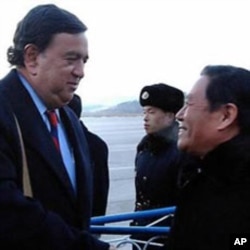
Richardson, who is now governor of the U.S. state of New Mexico, passed through Beijing Tuesday on his way out of Pyongyang.
"I noticed a pragmatic attitude on their [North Korea's] part, a more realistic attitude, a view perhaps that they had moved a little too far down the precipice, and that it was time to come back and pull back and start negotiations again. I did notice that and when I pushed hard for non-retaliation, I saw a little bit of movement in a positive direction," he said.
His comments referred to North Korea's stepping back from threats of a military response to South Korean artillery drills on Monday.
Richardson was on a private trip aimed at easing tensions, and did not represent the U.S. government.
The Chinese spokeswoman says Beijing always supports any contacts between the United States and North Korea. Jiang says China hopes this latest meeting will contribute to a speedy resumption of the six-party talks.