News / Asia

    China Rejects US Report on Sea Claims

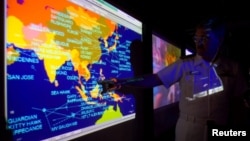
    United States Navy lieutenant commander Kirk Benson, points at a map of the South China sea at the Tactical Flag Command Center (TFCC) of the 19,200-ton USS Blue Ridge in Manila, July 22, 2014.
    United States Navy lieutenant commander Kirk Benson, points at a map of the South China sea at the Tactical Flag Command Center (TFCC) of the 19,200-ton USS Blue Ridge in Manila, July 22, 2014.
    Shannon Van Sant

    China rejected a U.S. government report detailing Beijing's maritime territorial claims in the South China Sea, saying the document violates Washington's pledge to remain neutral in the dispute.

    Both Beijing and Washington released reports in the past week that weighed-in on the longstanding dispute over who owns the scores of reefs, small islands and surrounding waters of the resource rich South China Seas.

    A U.S. State Department report examined the historic, geographic and legal basis for China’s vast claims in the strategic region, concluding that they do not accord with the international law of the sea, based on the U.N. treaty that China has signed.

    That drew a sharp response from China’s foreign ministry.

    Watch report by VOA State Department correspondent Scott Stearns
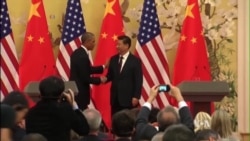
    US-China Year in Review: Hong Kong to Climate Changei
    X
    Scott Stearns
    December 15, 2014 5:35 PM
    The United States is pushing for a code of conduct to resolve territorial disputes in the South China Sea as it works to improve commercial ties with Beijing. VOA State Department correspondent Scott Stearns reports on a year of U.S. policy toward China from Hong Kong to climate change.


    US to take no sides

    Spokesperson Hong Lei said China’s rights and claims in the sea are formed by history and upheld by Chinese governments. Hong said the U.S. report violates its commitment of taking no sides in the South China Sea issue.  
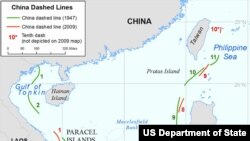
    A map showing differences in China's maritime claims in the South China Sea, based on maps created by China in 1947 and 2009.A map showing differences in China's maritime claims in the South China Sea, based on maps created by China in 1947 and 2009.
    x
    A map showing differences in China's maritime claims in the South China Sea, based on maps created by China in 1947 and 2009.
    A map showing differences in China's maritime claims in the South China Sea, based on maps created by China in 1947 and 2009.

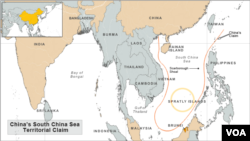
    China’s territorial claims in the South China Sea are outlined in maps containing the so-called nine-dash line, a boundary that encloses water, islands and other features of the resource-rich sea.
    This includes territory that has long been claimed by other nations, including Vietnam and the Philippines.

    The Philippines has appealed for international arbitration in the dispute under the U.N. Convention on the Law of the Sea (UNCLOS).

    China has until December 15 to defend its position, but Beijing has already signaled that it will not participate in the process.

    In a government report published Sunday, Beijing made the case that the territorial disputes must first be worked out between the nations before any international arbitration can move forward.

    China has long rejected having the United Nations or other international body help adjudicate the dispute, preferring to deal with the disagreements one-on-one with other nations.

    The study by the U.S. State Department’s Bureau of Oceans and International Environment and Scientific Affairs (OES), said China, in backing its claim, is using maps that date back to 1947, but the maps “lack precision” and are too inconsistent to form as the basis for its historical claim to the waterway.  

    The study also said there is no “Chinese law, declaration, proclamation or other official statement describing and putting the international community on notice of a historical claim to the waters within the dashed line.”  

    It said that China’s historical claim fails to meet the legal tests used in international law for addressing these kinds of disputes.

    Carl Thayer, a professor at the Australian Defense Force Academy, said while the Chinese paper seeks to influence judges in the arbitration case without direct engagement, the U.S. study presses China forcefully for clarification on its territorial claims.  
    Click to enlargeClick to enlarge
    x
    Click to enlarge
    Click to enlarge

     “China can take out lines, they can add them as they have, around Taiwan, the 10th line,” Thayer said. “So these lines are not as fixed as China would like us to believe. So the U.S. has set the ball rolling in helping push the legal argument further.”  

    Maritime zones agreed upon

    The U.S. study also said that China’s claims are contrary to the provisions on maritime zones of UNCLOS, which were accepted by China as a signatory to the convention.  Those provisions favor sovereign rights of a coastal state over historical claims.

    It concluded that China cannot use the nine-dash line to unilaterally establish maritime boundaries with other countries and that China needs to “clarify its claim.”  

    Wang Dong, a professor of international relations at Peking University, said the U.S. paper and the Philippines’ initiation of arbitration is not constructive to resolving the dispute.  

    “It’s not helpful in calming things down in the South China Sea,” Wang said. “It might stir, unnecessarily, things up and embolden some of the claimant countries to not engage in negotiation on good faith and instead try and take a confrontational approach towards this issue.”

    The South China Sea is contested by several nations. It is one of the busiest shipping lanes in the world and rich in potential minerals, oil and gas resources.

    China said the outcome of the arbitration case will not “shake China’s resolve and determination to safeguard its sovereignty and relevant maritime rights and interests.”

    You May Like

    Why Syria Election Will Hand Assad Victory

    Outcome is foregone conclusion, say opposition politicians and independent election experts who dub next week’s wartime poll a PR stunt

    Victims of Violence Focus Gun Laws in 2016 Campaign

    In New York City, grieving family members of people killed by guns gather at City Hall to urge for more restrictive gun measures

    Closed Borders, Changing Rules Splinter Families Fleeing War

    Greece now faces uncertainty with more than 50,000 refugees, migrants trapped on northern border with Macedonia and crowded into camps, detention centers and makeshift settlements

    This forum has been closed.
    Comment Sorting
    Comments
         
    by: John from: Irvine
    December 11, 2014 3:19 PM
    We should also publish our stances on the occupation of Tibet, Xinjiang, and Inner Mongolia as part of china sovereignties are also questionable and highly disputable.
    In Response

    by: Jesse
    December 12, 2014 2:53 PM
    They must stop occupy Tibet.
    A large amount of radioactive waste from China's nuclear power plants has been sent all the way to Tibet and dumped there.
    Tibet is just a useful final disposal site for them.
    It's unfortunate,but nonviolent protests by Tibetan people don't work anymore,so the world should support them right away.
    In Response

    by: Anonymous
    December 12, 2014 9:00 AM
    What about your occupation at Okinawa, where locals are quite sick of you hipocrites.And your presence in Afghanistan which triggers anti American complex in the Middl East.

    by: Liu Liang from: China
    December 11, 2014 2:45 PM
    How stupid you are by saying to ban all Chinese products and wage a war to China! Are you headless or losing your mind?Yes, maybe we are not militaril as strong as what you are now.Anyway, China is a nuclear power as you do. We will never be hazed by anyone.
    In Response

    by: Marcus Aurelius II from: NJ USA
    December 12, 2014 3:05 PM
    If you think China can simply claim all of the South China Sea as its territory and demand whatever it wants from others to use it you are dreaming. It will not be allowed to colonize or even intimidate its neighbors.

    China is a paper tiger. Most of its GDP goes to foreign firms as their profits. On its own China invents nothing. All it can do is copy what others have dreamt up. China is a cheap job shop to ship out jobs to that are too dirty, too labor intensive, too repetitive that can be done with unskilled and semi-skilled labor for dirt cheap. There are no enforceable labor or environmental laws and Chinese workers have no recourse to sue if they are injured on the job. China skims a little off the top and has horded it as savings. It should not get too full of itself. The price it has paid is to turn itself into a vast chemical waste dump. Everything is being contaminated. It's continued survival depends on continuing to be an exporter.

    When products from China continue to arrive in the West that poison us, our children, our pets we won't need to put an embargo on China. Made in China will come to mean potentially poisonous, don't touch. Already many Chinese themselves don't trust their own food supply and the air and water are far too polluted to breathe and drink. China is now a horrible place to live. That's why so many pay thousands to snakeheads to get them out.
    In Response

    by: meanbill from: USA
    December 11, 2014 5:55 PM
    DON'T WORRY, because almost all of the largest super wholesale and retail stores in America would go broke if they didn't have Chinese goods to sell, and both countries [no matter the animosity] need each other in this new competitive world.....

    DON'T WORRY, because the US with the greatest military and weapons in the history of the world, hasn't defeated any of third world countries, [or terrorist groups], they have fought against since WW2, [and no matter what], we Americans would never attack a country [no matter how small and weak], that possesses nuclear weapons..... [you can count on that].

    by: Marcus Aurelius II from: NJ USA
    December 11, 2014 10:34 AM
    China's economy is even more vulnerable than Russia's. For example, were the US to impose an import ban on all Chinese exports China's financial markets would collapse in a matter of hours. The US would hurt its own economy temporarily because much of what exists in China is owned by Americans. GDP with or without PPP is meaningless. What really matters is GNI and GNI per capita not adjusted for PPP. On that basis, China is not a very large economy at all. Why do economists perpetuate the myth of comparing GDPs? Who really knows? It's an illusion.
    In Response

    by: Marcus Aurelius II from: NJ USA
    December 12, 2014 3:12 PM
    Raj from Japan have you seen what's happening to the Russian Ruble, the Russian economy, the price of oil, outflows of capital from Russia, desperation to find buyers for anything it can sell? Russia's economy is headed for a deep depression. Interest rates are already at 10.5%, the Ruble over 58 to the US dollar, Brent crude under $63 a barrel. Watch it grow worse by the hour practically every day that currency and oil are traded. And all because it tired to keep Ukraine as a colony and seized Crimea. The same and worse could be done to China even more rapidly if it does not cease its aggression.
    In Response

    by: raj from: Japan
    December 12, 2014 1:17 PM
    That is exactly your people thought when they imposed economical sanctions on Russia and look how much of difference has that make, you people think your country has control over whole world what you don't realize is that its not 1922 any more time , people and sanctions has changed .
    In Response

    by: RS
    December 11, 2014 1:16 PM
    Good and excellent idea: ban all Chinese products and we'll see. All this because of Nixon and Billy the Kid Clinton who has irresponsibly approved of China's entry into the World trade Organization.

    by: meanbill from: USA
    December 11, 2014 9:58 AM
    REMEMBER that there was a time, [a hundred years of humiliation], that the US and European countries, Japan and Russia forced China to accept the terms of "Gunboat Treaties" and "Unequal Treaties" by force of arms, [but now], those days are long gone, and China now says it will never ever give up 'one inch' of the motherland again, [or], any inch of the sovereign air, sea or land, of the Chinese motherland.... [Is it a promise to the Chinese people, or a warning to those who'd try to take 'one inch' of the sovereign air, sea or land, of the Chinese motherland?].....

    QUESTION?.... Can the US still force China to accept another "Gunboat Treaty" or another "Unequal Treaty" and another hundred years of humiliation, today?.....[we'll see. won't we?]..... [no matter what the US says, China is not in violation of any law of the sea, or in violation of any other international law?]..... [the US unsupported claims are just more phony bias propaganda without any supporting legal documentation]..... [crazy isn't it?]..... [the US should take their claims to the UN, even though what they claim, hasn't anything to do with the sovereignty of American air, sea or land?].
    In Response

    by: Marcus Aurelius II from: NJ USA
    December 11, 2014 12:15 PM
    The US can and will force China to restrict its claims according to internationally recognized limits on territorial waters and the rest of China's claims will remain the open sea for anyone to use without restriction. Can the US impose this by military force if it must? The answer is an unqualified YES WE CAN!

    Questions exist about the US commitment to defend Taiwan and other nations from China but there should be no mistake, the US MUST defend Japan under terms of a treaty and it will. Forced to choose there is no choice. If China launches a war against Japan over territory, it will be launching a war against the US as well, a war it has no hope of winning. China should focus instead on dealing with other countless problems it has instead of unnecessarily creating new ones for itself. It should not repeat Russia's mistake.

    Featured Videos

    Your JavaScript is turned off or you have an old version of Adobe's Flash Player. Get the latest Flash player.
    Spotlight Falls on London as British PM Admits to Profits From Offshore Firmi
    X
    April 08, 2016 10:59 PM
    British Prime Minister David Cameron has admitted that he had profited from a so-called "shell" company set up by his late father. This follows revelations about the scale of offshore wealth exposed by a leak from a Panama-based law firm earlier this week. But it’s Britain’s wider role in the system of offshore finance that is coming under greater scrutiny - as Henry Ridgwell reports from London.
    Video

    Video Spotlight Falls on London as British PM Admits to Profits From Offshore Firm

    British Prime Minister David Cameron has admitted that he had profited from a so-called "shell" company set up by his late father. This follows revelations about the scale of offshore wealth exposed by a leak from a Panama-based law firm earlier this week. But it’s Britain’s wider role in the system of offshore finance that is coming under greater scrutiny - as Henry Ridgwell reports from London.
    Video

    Video Phnom Penh Transforming Overnight with Foreign Investment

    Foreign investors are rushing into Cambodia's frontier property market. Phnom Penh is rising upward almost overnight, but the rate of construction is raising questions about where all the investment is coming from and what effect it will have on the local market. David Boyle reports from the Cambodian capital.
    Video

    Video Panama Tax Haven Revelations Show How Neediest Nations Are Harmed

    The Panama Papers — documents leaked from a Panamanian law firm — reveal a shady side to the global financial system, in which the world’s elite routinely hide money to remain anonymous or to avoid paying taxes. While some argue there’s nothing illegal about the practice, others say the lack of transparency and controls in many tax haven countries comes with a heavy price tag, especially in countries where development money is needed most. VOA's Mil Arcega reports.
    Video

    Video Soap-making Factories Bring Economic Relief to Syrian Town

    War in Syria, now in its fifth year, has adversely affected businesses and local industries. But in one district of the country, the soap-making industry is trying to get back on its feet and providing much-needed employment opportunities to the local population. With Robert Raffaele narrating, VOA’s Amina Misto reports.
    Video

    Video Stranded in Greece, Afghan Interpreters Feel Abandoned By US, Coalition

    Among the tens of thousands of refugees stranded in Greece are many Afghan nationals -- including some who tell VOA they were forced to flee threats from the Taliban because they had worked with US and coalition forces. The United States has a special visa to help Afghans and Iraqis who worked with the US military to gain asylum -- but the refugees say the system takes far too long, and they had to flee for their lives. Henry Ridgwell reports from Athens.
    Video

    Video Experts: IS Looting Antiquities on Industrial Scale

    Experts say the Islamic State is looting and selling cultural antiquities from Iraq and Syria on an industrial scale. The destruction and sale of these treasures is not only condoned but has been institutionalized within the Islamic State itself. And as Jeff Swicord reports, artifacts are beginning to show up on antiquities markets around the world.
    Video

    Video Deportations Bring Unease to Turkey

    Turkey is expecting to receive 200 more migrants deported from Greece on Friday. It is part of the deal reached in March between the European Union and Ankara to alleviate Europe’s migrant crisis. But there is also nervousness among some Turks who question whether their country can and should absorb the refugees who do not return to their nations of origin. VOA Europe Correspondent Luis Ramirez reports.
    Video

    Video Scientists Creating New Devices to Battle Diabetes

    Diabetes is fast becoming a major global problem, affecting 422 million people. But nanotechnology may someday make monitoring blood glucose levels and administering medicine much simpler than it is today. VOA’s George Putic reports.
    Video

    Video Spanish ‘Smart’ City Project Saves Time, Money

    As life in cities worldwide becomes more hectic and more expensive, urban designers are resorting to modern technology to help citizens avoid traffic snarls, and shorten the time needed for shopping and other errands. Technology also is used to cut costly waste. Zlatica Hoke has this report about a city in Spain that is turning into a model "smart city" others seek to emulate.
    Video

    Video New Abidjan Car Services Inspired by Uber

    Uber, the U.S.-based online transportation network company, operates a mobile app that allows consumers with smartphones to book cab service from Uber drivers who use their own cars. As the company makes inroads in Africa, entrepreneurs in the West African nation of Ivory Coast are trying to stay one step ahead. Emilie Iob reports from the Ivorian commercial capital, Abidjan, where at least four Uber-like car services have launched since last year.
    Video

    Video Young Yazidi Refugee Paints About Islamic State 'Nightmare'

    Mariam Marwan was 16 when Islamic State militants stormed her village in Iraq, forcing her family to flee to the Sinjar Mountains. Now 18, Miriam says she constantly relives the nightmare but hopes her images will serve as a record of what happened to the Yazidi people.
    Video

    Video Top Honor Given to US Military Dog Injured in Combat

    A U.S. Military Service dog that saved the lives of thousands of troops by sniffing out explosives has been awarded the highest honor of bravery by a British animal charity. Henry Ridgwell met Lucca the German Shepherd at an award ceremony in London and reports for VOA.

    Special Report

    Adrift The Invisible African Diaspora