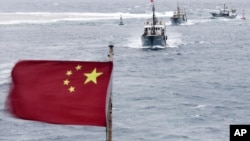
China has warned Vietnam to stop "unilateral oil and gas exploration" in disputed areas of the South China Sea, as the two countries' long-standing maritime dispute continues to heat up.
Foreign Ministry spokesperson Hong Lei's comments Thursday come after Vietnam's state-owned oil and gas company accused Chinese vessels of cutting a cable on one of its ships last week. Vietnam's foreign ministry calls the incident a "serious violation" of its sovereignty.
Hong says the Vietnamese accusation was "inconsistent with the facts," arguing that the Chinese vessels were conducting "completely justified" fishing activities in a disputed area near China's southern Hainan province.
Police in Hainan have recently been given new powers to board and seize ships that enter what China considers to be its waters there, raising already heightened regional tensions.
Many of China's neighbors are concerned about its increasingly aggressive posture in defending its claim to the 3.5-million-square kilometer South China Sea.
China claims nearly the entire oil- and gas-rich sea as its own, despite overlapping claims by Vietnam, the Philippines, Vietnam, Brunei and Malaysia.
Beijing has rejected attempts to resolve the disputes using multilateral mechanisms, such as the Association of SouthEast Asian Nations. It instead prefers to deal individually with each of its weaker rival claimants.
On Thursday, Hong said China and Vietnam are engaged in negotiations. He said there would be a "more friendly atmosphere" for those talks if Vietnam stopped its oil exploration and did not interfere with Chinese vessels.
Foreign Ministry spokesperson Hong Lei's comments Thursday come after Vietnam's state-owned oil and gas company accused Chinese vessels of cutting a cable on one of its ships last week. Vietnam's foreign ministry calls the incident a "serious violation" of its sovereignty.
Hong says the Vietnamese accusation was "inconsistent with the facts," arguing that the Chinese vessels were conducting "completely justified" fishing activities in a disputed area near China's southern Hainan province.
Police in Hainan have recently been given new powers to board and seize ships that enter what China considers to be its waters there, raising already heightened regional tensions.
Many of China's neighbors are concerned about its increasingly aggressive posture in defending its claim to the 3.5-million-square kilometer South China Sea.
China claims nearly the entire oil- and gas-rich sea as its own, despite overlapping claims by Vietnam, the Philippines, Vietnam, Brunei and Malaysia.
Beijing has rejected attempts to resolve the disputes using multilateral mechanisms, such as the Association of SouthEast Asian Nations. It instead prefers to deal individually with each of its weaker rival claimants.
On Thursday, Hong said China and Vietnam are engaged in negotiations. He said there would be a "more friendly atmosphere" for those talks if Vietnam stopped its oil exploration and did not interfere with Chinese vessels.
Some information for this report was provided by AP and Reuters.