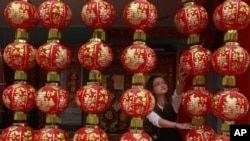



Millions of Asians mark the start of a new Lunar New Year on February 3. The year of the rabbit is expected to bring some uncertainty.
Across China, millions of people already have commenced sometimes days-long journey to return to their hometowns for the Lunar New Year celebrations.
Most factories and offices are closed for several days starting Saturday, and migrant workers from the cities pack trains and buses. For some it is their only chance to see their families each year. The Ministry of Railways forecast 230 million passengers this season, up 12.5 percent from last year.
Some will head Hong Kong, where the Tourism Board has spent about $2 million to attract mainland tourists to its annual New Year’s parade.
Residents of Hong Kong and Taiwan also are traveling, with flights booked months ago, to take advantage of the three-day holiday.
In the Chinese almanac, the year that starts February 3rd year will be the year of the rabbit - which Chinese feng shui experts say is marked by volatility and conflicts.
Feng shui is a popular Chinese system of harmonizing nature’s elements - water, wood, earth, fire and metal.
Investment bank CLSA Asia Pacific Markets publishes an annual feng shui report on the stock market. This year, the report tells investors to buy metal, marine, airline, financial and gaming stocks to take advantage of the strong metal and water elements during a rabbit year.
Philip Chow, an analyst at CLSA in Hong Kong, says earth-related stocks will lag behind.
"The presence of wood is bad for earth in Chinese feng shui," said Chow. "The relatively unexciting sectors would include real estate, construction and building materials."
Taiwan, Singapore, South Korea and Vietnam will also be celebrating the new Lunar New Year. Although Thailand marks its new year separately, in Bangkok, large department stores display rabbit decorations and showcase Chinese food.
But higher food prices damp the celebratory atmosphere. In Vietnam, consumers complain about expensive cooking oil, vegetables, fruit and even the flowers used for traditional decorations. Consumer prices in January surged more than 12 percent.
In Taipei, the city government says prices of popular holiday foods have risen as much as 13 percent from last year. In mainland China, inflation reached 4.6 percent in December.
China Welcomes the Year of the Rabbit
- By Heda Bayron