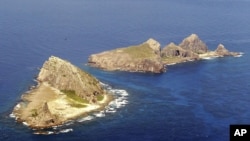
The chain of uninhabited islands at the center of a territorial dispute between China and Japan sits on top of what are thought to be vast oil deposits, and are surrounded by rich fishing grounds.
But the islands, known as Senkaku in Japanese and Diaoyu in Chinese, have a long history of straining relations and inspiring nationalist resentment between the two Asian neighbors, long before the issue of oil resources in the area came up.
China says the islands have been considered part of its territory since the 14th century, when it says they first appeared on Chinese maps during the Ming Dynasty. Beijing says Chinese fishermen have used the islands since ancient times.
But Japan disputes that claim, saying it discovered the islands in 1884. After determining the islands were uninhabited, Japan annexed them in 1895 after winning the First Sino-Japanese War. China objects, saying it was forced to sign the post-war treaty that effectively handed the islands over to Japan.
Japan controlled the Senkaku Islands until after World War II, when they came under temporary control of the United States. China does not recognize the 1951 Treaty of San Francisco, under which Japan transferred control of the islands to Washington.
In 1972, the United States transferred the islands back to Japan.
Minor sporadic incidents between China and Japan have broken out near the islands since the early 1970s, when reports surfaced that there may large oil and gas reserves beneath them. The incidents have mostly involved small face-offs between fishing vessels from each country.
A serious diplomatic incident erupted in 2010, when Japan arrested the captain of a Chinese fishing boat that collided with a Japanese coast guard vessel near the islands. Tokyo released the captain, but only after Beijing postponed certain bilateral talks and suspended some trade ties.
More recently, Tokyo's governor offered to purchase the disputed islands using public money, sparking an angry response from China. And earlier this week, Japan arrested 14 Chinese activists who planted a flag on the islands. They were released two days later.
The islands are also claimed by Taiwan.
But the islands, known as Senkaku in Japanese and Diaoyu in Chinese, have a long history of straining relations and inspiring nationalist resentment between the two Asian neighbors, long before the issue of oil resources in the area came up.
China says the islands have been considered part of its territory since the 14th century, when it says they first appeared on Chinese maps during the Ming Dynasty. Beijing says Chinese fishermen have used the islands since ancient times.
But Japan disputes that claim, saying it discovered the islands in 1884. After determining the islands were uninhabited, Japan annexed them in 1895 after winning the First Sino-Japanese War. China objects, saying it was forced to sign the post-war treaty that effectively handed the islands over to Japan.
Japan controlled the Senkaku Islands until after World War II, when they came under temporary control of the United States. China does not recognize the 1951 Treaty of San Francisco, under which Japan transferred control of the islands to Washington.
Japan and China's Disputed Islands
Japan and China's Disputed Islands- Known as Senkaku in Japanese and Diaoyu in Chinese
- Uninhabited archipelago of 8 islands
- Located in gas-rich area and surrounded by rich fishing grounds
- The islands have a land area of about 6 square kilometers
Minor sporadic incidents between China and Japan have broken out near the islands since the early 1970s, when reports surfaced that there may large oil and gas reserves beneath them. The incidents have mostly involved small face-offs between fishing vessels from each country.
A serious diplomatic incident erupted in 2010, when Japan arrested the captain of a Chinese fishing boat that collided with a Japanese coast guard vessel near the islands. Tokyo released the captain, but only after Beijing postponed certain bilateral talks and suspended some trade ties.
More recently, Tokyo's governor offered to purchase the disputed islands using public money, sparking an angry response from China. And earlier this week, Japan arrested 14 Chinese activists who planted a flag on the islands. They were released two days later.
The islands are also claimed by Taiwan.