



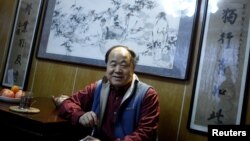
Chinese author Mo Yan has won the Nobel Prize in Literature for work that the prize committee says has qualities of "hallucinatory realism."
The Royal Swedish Academy in Stockholm on Thursday announced the winner of the prestigious prize, which is worth $1.2 million.
"The Nobel Prize in literature for 2012 is awarded to the Chinese writer Mo Yan, who with hallucinatory realism merges folk tales, history and the contemporary,'' said Permanent Secretary of the Swedish Academy Peter Englund.
Englund said the academy contacted Mo before the prize was announced.
"He said he was overjoyed and scared," Englund said.
Mo is the first Chinese national to win the Nobel literature prize, but he is not the first Chinese-language writer to do so. A Chinese emigre to France, Gao Xingjian, won in 2000. His works criticize China's communist government and have been banned in China.
Premier Chinese author
Mo is one of China's top contemporary authors. His writings draw on his youthful experiences and on settings in the region where he was born - Shandong province in northeastern China.
Mo Yan
This is apparent in his 1987 novel, Hong Gaoliang Jiazu, which was published in English as Red Sorghum in 1993. The book is about the brutal violence that plagued the eastern China countryside during China's Communist Revolution in the 1920s and 1930s. It includes depictions of bandit culture, Japanese occupation and the harsh conditions endured by farm workers.
That story was later made into an acclaimed movie by leading Chinese director Zhang Yimou.
His other significant works include Big Breasts and Wide Hips, Republic of Wine and Life and Death are Wearing Me Out.
The Royal Swedish Academy compared him to two other notable authors of the 20th century, American William Faulkner and Colombian Gabriel Garcia Marquez.
"Through a mixture of fantasy and reality, historical and social perspectives, Mo Yan has created a world reminiscent in its complexity of those in the writings of William Faulkner and Gabriel García Márquez, at the same time finding a departure point in old Chinese literature and in oral tradition," the academy said in a statement. "In addition to his novels, Mo Yan has published many short stories and essays on various topics, and despite his social criticism is seen in his homeland as one of the foremost contemporary authors."
Mo Yan is a pen name that means "Don't Speak."
Studied literature in 1970s
The 57-year-old author, whose real name is Guan Moye, was born in 1955 and grew up in Gaomi in Shandong province. His parents were farmers. As a 12-year-old during China's Cultural Revolution, he left school to work, first in agriculture and later in a factory.
In 1976, he joined China's People's Liberation Army and began to study literature and write.
His first short story was published in a literary journal in 1981. His breakthrough came in 1986 with the novella Touming de Hong Luobo, published in French as Le Radis de Cristal in 1993.
Nobel prize announcements began on Monday, with the medicine award going to stem cell researchers John Gurdon of Britain and Japan's Shinya Yamanaka. Frenchman Serge Haroche and American David Wineland won the physics prize on Tuesday for work on quantum particles.
Americans Robert Lefkowitz and Brian Kobilka won the chemistry prize on Wednesday.
The prestigious Nobel Peace Prize will be announced on Friday.
The Royal Swedish Academy in Stockholm on Thursday announced the winner of the prestigious prize, which is worth $1.2 million.
"The Nobel Prize in literature for 2012 is awarded to the Chinese writer Mo Yan, who with hallucinatory realism merges folk tales, history and the contemporary,'' said Permanent Secretary of the Swedish Academy Peter Englund.
Englund said the academy contacted Mo before the prize was announced.
"He said he was overjoyed and scared," Englund said.
Mo is the first Chinese national to win the Nobel literature prize, but he is not the first Chinese-language writer to do so. A Chinese emigre to France, Gao Xingjian, won in 2000. His works criticize China's communist government and have been banned in China.
Premier Chinese author
Mo is one of China's top contemporary authors. His writings draw on his youthful experiences and on settings in the region where he was born - Shandong province in northeastern China.
2012 Nobel Prize in Literature
2012 Nobel Prize in LiteratureMo Yan
- Born in 1955, grew up in Shandong province in northeastern China.
- First short story published in a literary journal in 1981.
- Breakthrough work was Touming de hong loubo, first published in Chinese in 1986.
- Seen as one of the foremost contemporary authors in China.
- The Royal Swedish Academy said his work "with hallucinatory realism merges folk tales, history and the contemporary."
That story was later made into an acclaimed movie by leading Chinese director Zhang Yimou.
His other significant works include Big Breasts and Wide Hips, Republic of Wine and Life and Death are Wearing Me Out.
The Royal Swedish Academy compared him to two other notable authors of the 20th century, American William Faulkner and Colombian Gabriel Garcia Marquez.
"Through a mixture of fantasy and reality, historical and social perspectives, Mo Yan has created a world reminiscent in its complexity of those in the writings of William Faulkner and Gabriel García Márquez, at the same time finding a departure point in old Chinese literature and in oral tradition," the academy said in a statement. "In addition to his novels, Mo Yan has published many short stories and essays on various topics, and despite his social criticism is seen in his homeland as one of the foremost contemporary authors."
Mo Yan is a pen name that means "Don't Speak."
Studied literature in 1970s
The 57-year-old author, whose real name is Guan Moye, was born in 1955 and grew up in Gaomi in Shandong province. His parents were farmers. As a 12-year-old during China's Cultural Revolution, he left school to work, first in agriculture and later in a factory.
In 1976, he joined China's People's Liberation Army and began to study literature and write.
His first short story was published in a literary journal in 1981. His breakthrough came in 1986 with the novella Touming de Hong Luobo, published in French as Le Radis de Cristal in 1993.
Nobel prize announcements began on Monday, with the medicine award going to stem cell researchers John Gurdon of Britain and Japan's Shinya Yamanaka. Frenchman Serge Haroche and American David Wineland won the physics prize on Tuesday for work on quantum particles.
Americans Robert Lefkowitz and Brian Kobilka won the chemistry prize on Wednesday.
The prestigious Nobel Peace Prize will be announced on Friday.
Some information for this report was provided by AP, AFP and Reuters.