BEIJING —
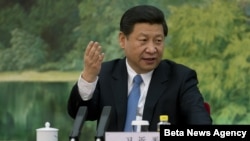
China's National People's Congress has voted to elect Xi Jinping as the country's next president. The largely ceremonial procedure marks the completion of China’s once in a decade leadership transition that began late last year. Over the past few months, Mr. Xi and China’s new team of leaders have been raising expectations here about the prospects for reform in this tightly ruled country.
In the space of just a few hours - representatives to China’s National People’s Congress voted unswervingly in support of Xi Jinping’s election to the post of president. Only one opposing vote was cast as well as three abstentions.
The result of the vote was never in doubt and there was an almost festive mood in China’s Great Hall of the People. Many delegates snapped photos of themselves while they were casting votes. Others sought Xi Jinping's autograph - as well as the autograph of the man tipped to become the country’s next premier Li Keqiang.
Li’s vote will be held Friday and there is little doubt of what the outcome of that election will be.
What remains unclear though, is how the two will handle China's immense challenges and growing calls for change.
Chinese officials have made it clear throughout the meetings of its National People's Congress that one option was not on the table - political reform.
China's National People's Congress
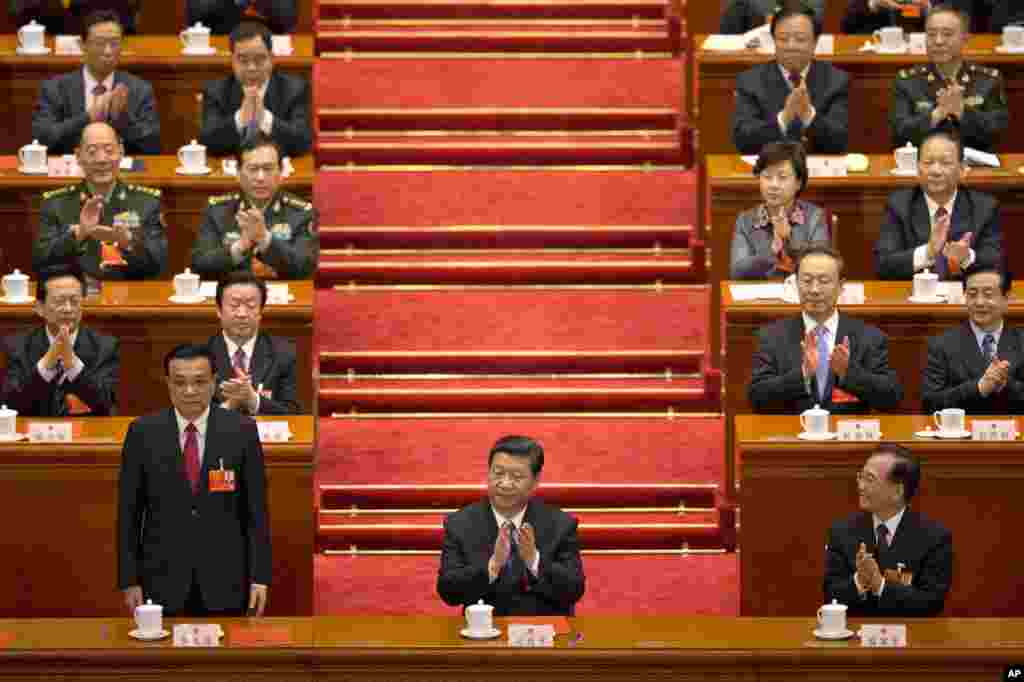
1/11Li Keqiang stands up when he was announced to be China's new premier, while Chinese President Xi Jinping and former Chinese Premier Wen Jiabao clap at Beijing's Great Hall of the People, March 15, 2013.
China's parliament has elected Li Keqiang premier as the country's Communist Party nears the final stages of its once-a-decade transition of power.
Show moreShow less
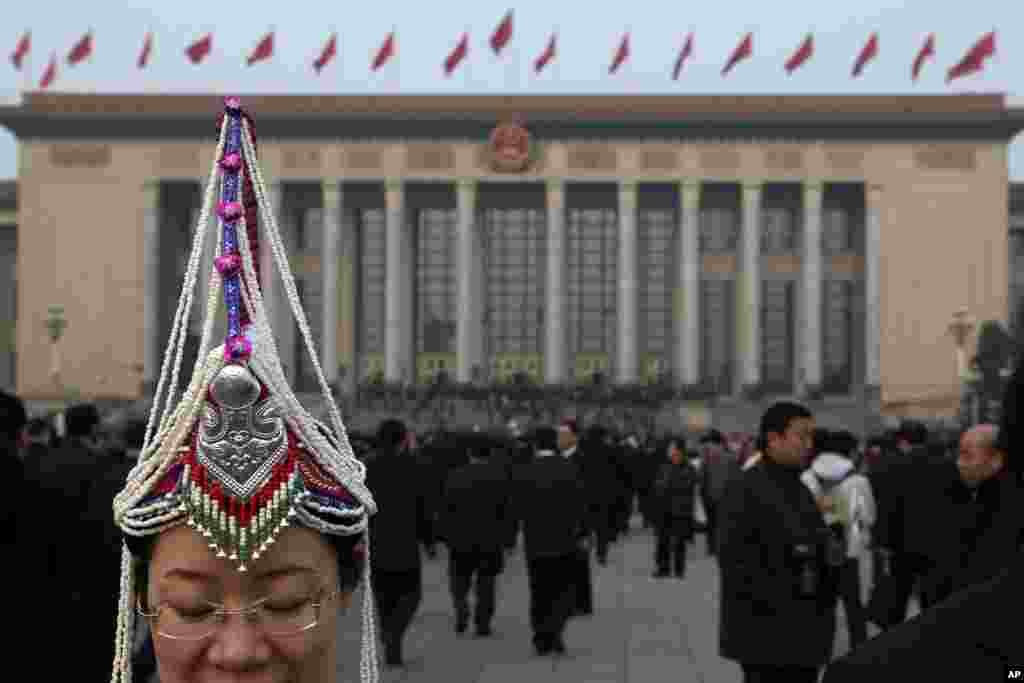
2/11A delegate wearing an ethnic minority costume arrives at the Great Hall of the People where a plenary session of the National People's Congress is held in Beijing, March 15, 2013.
China's parliament has elected Li Keqiang premier as the country's Communist Party nears the final stages of its once-a-decade transition of power.
Show moreShow less
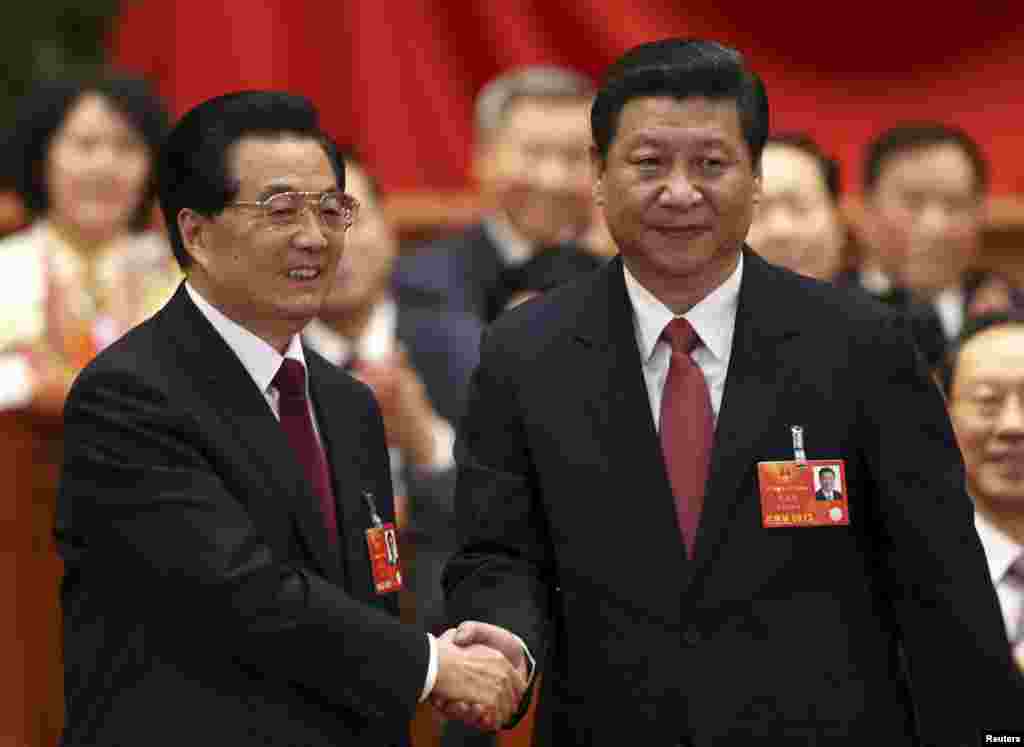
3/11Hu Jintao shakes hands with China's newly elected President and chairman of the Central Military Commission Xi Jinping during the fourth plenary meeting of the first session of the 12th National People's Congress (NPC) in Beijing, March 14, 2013.
China's parliament has elected Li Keqiang premier as the country's Communist Party nears the final stages of its once-a-decade transition of power.
Show moreShow less
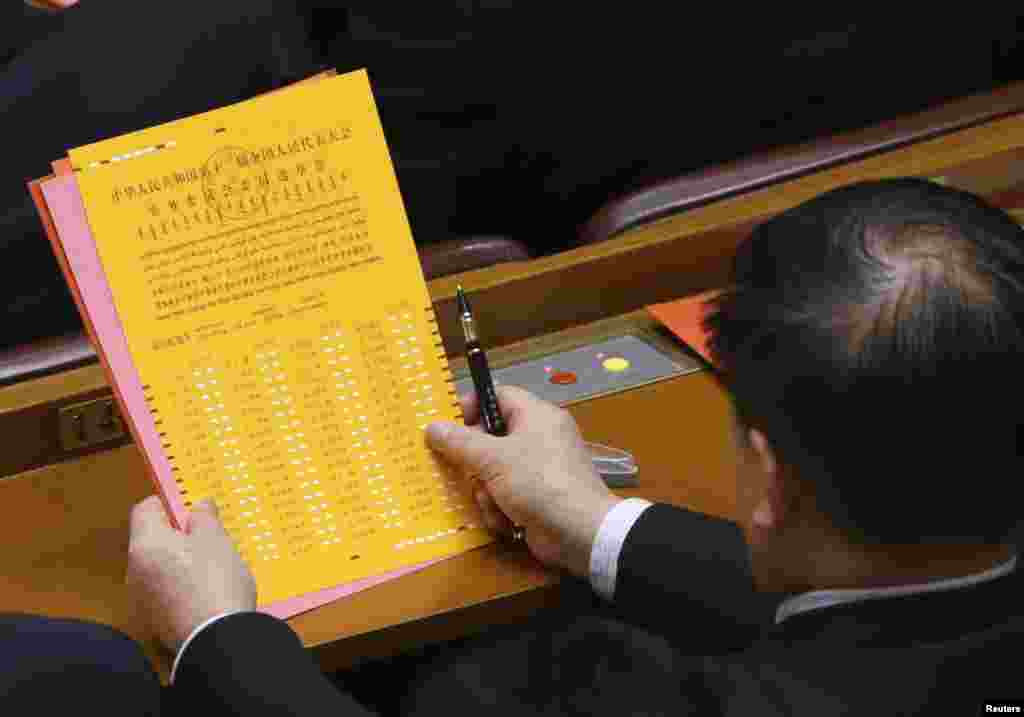
4/11A delegate looks at a ballot during the fourth plenary meeting of the National People's Congress (NPC) at the Great Hall of the People in Beijing, March 14, 2013.
China's parliament has elected Li Keqiang premier as the country's Communist Party nears the final stages of its once-a-decade transition of power.
Show moreShow less
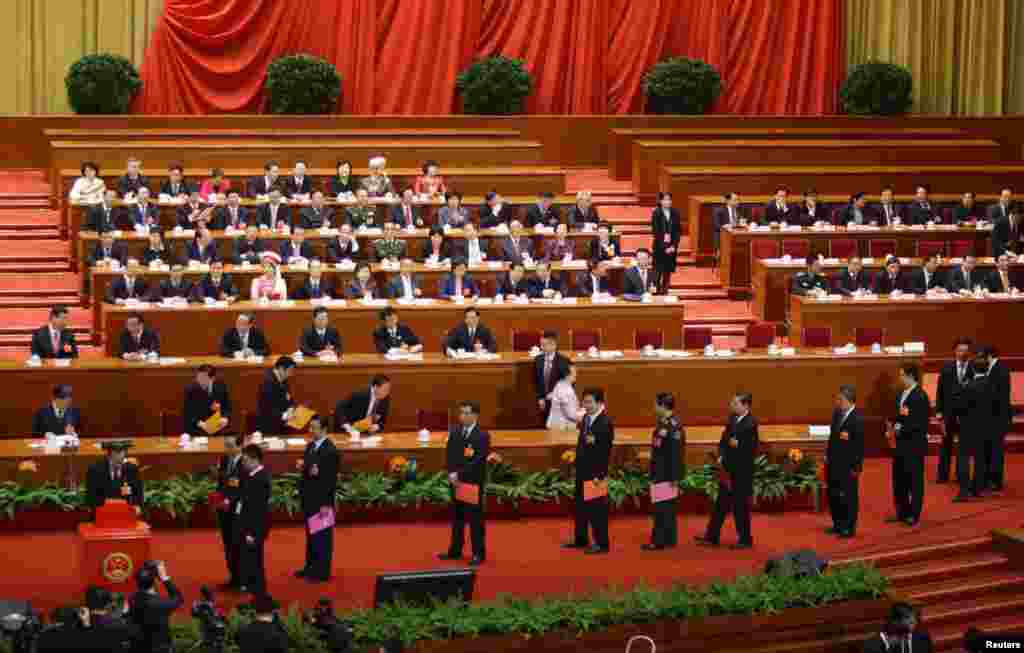
5/11Delegates vote during the fourth plenary meeting of National People's Congress (NPC) at the Great Hall of the People in Beijing, March 14, 2013.
China's parliament has elected Li Keqiang premier as the country's Communist Party nears the final stages of its once-a-decade transition of power.
Show moreShow less
6/11Chinese Premier Wen Jiabao gives the work report at the annual National People's Congress in Beijing's Great Hall of the People, March 5, 2013.
China's parliament has elected Li Keqiang premier as the country's Communist Party nears the final stages of its once-a-decade transition of power.
Show moreShow less
7/11Delegates press buttons to cast their approval for draft proposals during the opening session of the annual National People's Congress in Beijing's Great Hall of the People, March 5, 2013.
China's parliament has elected Li Keqiang premier as the country's Communist Party nears the final stages of its once-a-decade transition of power.
Show moreShow less
8/11A member of military music band yawns while others listen to Chinese Premier Wen Jiabao's speech at the annual National People's Congress at Beijing's Great Hall of the People, March 5, 2013.
China's parliament has elected Li Keqiang premier as the country's Communist Party nears the final stages of its once-a-decade transition of power.
Show moreShow less
9/11A female Ethnic minority delegate walks from the Great Hall of the People after attending the opening session of the National People's Congress in Beijing, March 5, 2013.
China's parliament has elected Li Keqiang premier as the country's Communist Party nears the final stages of its once-a-decade transition of power.
Show moreShow less
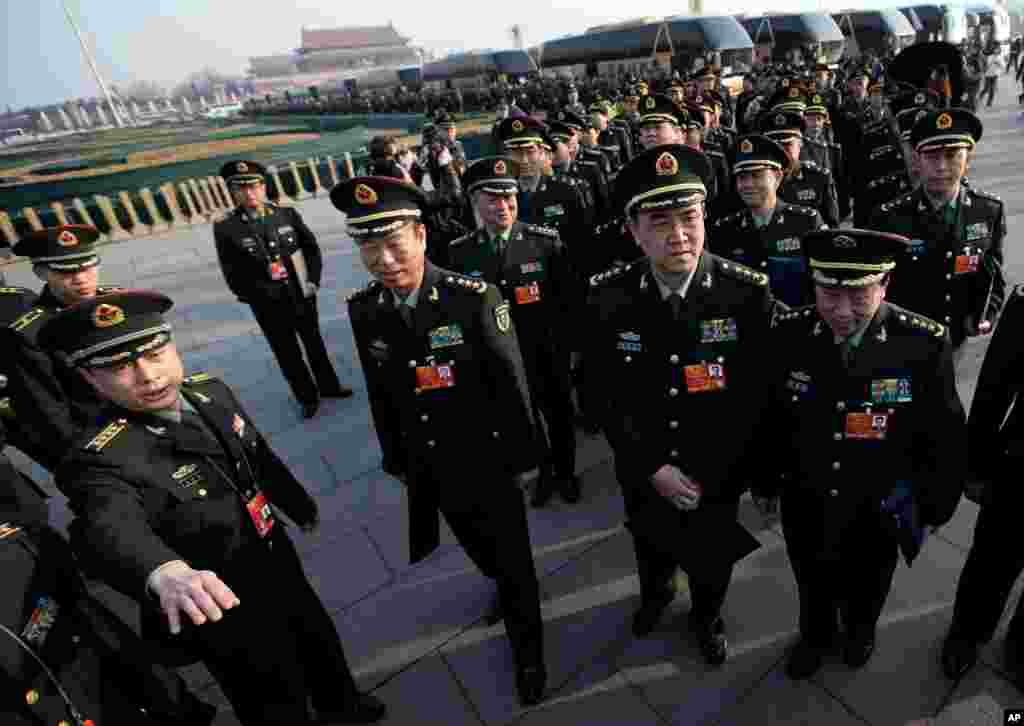
10/11Delegates from Chinese People's Liberation Army line up on Tiananmen Square as they prepare to walk toward the Great Hall of the People for the opening session of the National People's Congress, March 5, 2013.
China's parliament has elected Li Keqiang premier as the country's Communist Party nears the final stages of its once-a-decade transition of power.
Show moreShow less
11/11A delegate checks his mobile phone while officials' vehicles prepare to leave the Great Hall of the People after the opening session of the National People's Congress in Beijing, March 5, 2013.
China's parliament has elected Li Keqiang premier as the country's Communist Party nears the final stages of its once-a-decade transition of power.
Show moreShow less
Previous slide
Next slide
National People's Congress spokeswoman Fu Ying says it is unfair to say that China's style of political reform is not reform whenever it does not follow in the footsteps of other countries.
A headline in the English version of China's state-run Global Times was more blunt.
It read: “Socialist Path Reaffirmed, Constant Rejection of Western model sets reform tone.”
However, China is not rejecting all Western political ideas. In recent weeks there have been numerous reports in Chinese media about renewed interest in the writings of French historian Alexis de Tocqueville.
Wang Qishan, one of the seven members of Xi's new core team of leaders has recommend the author's book, the “Old Regime and Revolution,” to his associates.
That has many talking here about whether China is ripe for a revolution.
Chinese journalist Cheng Yizhong says the reason Wang Qishan and Xi are interested in the works of Tocqueville is because they want to learn about ruling and how to maintain their hegemonic power and keep threats at bay. Liberals and citizens, however, have a different view, Cheng says. They think China should put an end to its one party rule. They believe that if this does not happen China could undergo another revolution similar to the French Revolution, he says.
Some believe true change will not come until political reform is carried out.
Social activist and filmmaker Ai Xiaoming says that more than putting one's hopes in the country's leaders, ordinary citizens need to take action to help promote change.
Ai says you cannot just put your faith in [these leaders] who drink water that has been specially provided for them, whose families do not even live in China anymore. Ai says that when China's leaders assemble they just leave all the problems and criticism at the door. They do not allow people to speak up, to assemble, or protest in the streets.
China spends more money on public security than it does to fund its massive military. Public distrust in the country's leaders is a big concern, particularly as it relates to the problem of official graft.
China's Communist Party leaders have warned that corruption could kill the party and have been talking up the government's willingness to tackle corruption.
Xi says that the government will not only target lowly “flies” but higher ranking officials or “tigers” as well.