Chinese Activists Return From Expedition to Disputed Island
Captain Why Yang of Hong Kong fishing vessel "Kai Fung No.2" waves next to a Chinese national flag as he reaches in Hong Kong's island of Cheung Chau, August 22, 2012.
HONG KONG — After causing a diplomatic incident by planting the Chinese flag on the Japanese-controlled Senkaku Islands last week, a group of Chinese nationalists from Hong Kong arrived home Wednesday. Their announcement of a plan to return to the disputed islands, known as the Diaoyus in Chinese, threatens to escalate tensions between Beijing and Tokyo.
The fishing boat Kai Fung 2 slipped into Hong Kong Wednesday, its seven-man crew greeted as Chinese patriots after landing on the disputed Senkaku islands August 15, the anniversary of Japan’s World War II surrender.
Diplomatic incident
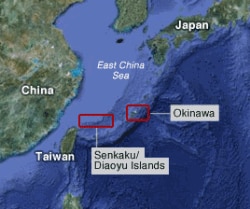
The activists sailed home from Okinawa after they were released from Japanese custody, having challenged Tokyo’s sovereignty over the territory located in the East China Sea, some 160 kilometers from Taiwan, 400 kilometers from Okinawa.
David Ko of the Action Committee for Defending the Diaoyu Islands, the group that organized the mission, accuses Japanese authorities of mistreating the detained crew.
"The room they were locked in was small and they had to urinate in a bottle," he said. "As you can see from the TV, at times they were handcuffed with a rope tied around their waist. As far as we’re concerned, that’s humiliating."
The islands constitute eight rocks measuring scarcely seven square kilometers. But their waters contain rich fishing grounds and potentially significant oil reserves.
Japanese landing
The action provoked Japanese nationalists to stage their own landing on the uninhabited islands this week. This sparked the largest anti-Japanese protests in China since 2005.
Despite Sino-Japanese tensions running high, Ko says plans are now being formulated for the Hong Kong activists to return to the disputed territory later this year.
"Territorial politics are changing," he said. "The Americans have shifted their focus back to the Pacific. And, China is unwilling to be surrounded. This is going to be a trouble spot in the near future - the South China Sea, all the way up to the north China Sea."
Possible policy shift in Beijing
Hong Kong activists make regular efforts to reach the Senkakus, but for two years have been restrained by the authorities in this special administrative region of China.
Analyst Johnny Lau suggests that the fact this was not the case with the Kai Fung 2 indicates a clear policy shift by the central government in Beijing.
"In 2021, Japan will stress it has controlled the Diaoyus for 50 years," he said. "In international law, Japan can [then] officially claim they are under [its] sovereignty. So the Chinese government has to do something to stop this. That is why they will try to use more assistance from the general public."
However, the Basic Law - Hong Kong’s mini-constitution drafted by Britain and China at the end of colonial rule in 1997 - strictly limits Hong Kong’s role in Chinese foreign affairs.
Debate about the constitutionality of the Diaoyu mission is noticeable by its absence. Even Hong Kong media reports that the government chief executive, CY Leung, helped fund the voyage of the Kai Fung 2 provoked little comment.
Any donation made in a private capacity is one thing, says Professor Bing Ling of the faculty of law at the Chinese University of Hong Kong. He says it is quite another if a donation was an official gift from the head of government.
"If that is the case, one would have to ask if the Hong Kong government has obtained authorization from Beijing to participate in and authorize this expedition. Obviously, if it does not have such authorization, it could not and should not have taken a step that directly implicates China in this territorial dispute," he said.
Who are the activists?
What has fueled discussion in Hong Kong about the ship’s mission is the unlikely political constituency represented aboard the Kai Fung 2. The majority of the Hong Kong activists landing on the disputed islands are renowned pro-democracy supporters.
More used to demanding China expand civic freedoms in Hong Kong than fighting the central government’s battles, several have faced jail for opposing Beijing. However, Lau argues that it is not inconsistent for pro-democrats to share the Communist Party’s views on pan-Chinese nationalism.
"They are described as dissidents by the Chinese government. But they went to the Diaoyu Islands to show the sovereignty of the Chinese government. [Now] the official Chinese media describes them as national heroes. The protection of the Diaoyus is a very unique issue," said Lau.
Sino-Japanese relations seem unlikely to improve in the short term. Chinese state media criticized Japan Tuesday for beginning a joint military exercise with the United States that they linked to Tokyo’s defense of its island territories.
Meanwhile, Hong Kong activists are planning a day of national protest against Japan September 18, marking the 81st anniversary of the Japanese invasion of northern China. This event, widely known as the Manchurian Incident, preceded the Second Sino-Japanese war by some six years.