


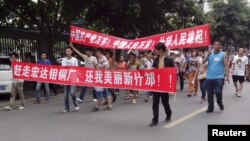
Chinese authorities have scrapped a plan to build a copper plant in a central city after thousands of residents staged three days of protests against the prospect of heavy pollution from the factory.
In a statement posted on its website, the government of Shifang city in Sichuan province said Tuesday it has stopped the metal plant project. Residents began street protests against the project late Sunday, complaining that factory emissions would poison them. Witnesses and officials said the demonstrations turned violent on Monday as riot police confronted thousands of protesters, resulting in at least 13 injuries.
Residents posted photos on the Internet of police firing tear gas and beating demonstrators with batons.
Witnesses said protesters returned to the streets on Tuesday, defying local government warnings against using the Internet and mobile phones to organize more demonstrations. The local government has called on protest organizers to turn themselves into police within three days or face "severe punishment."
Sichuan-based Chinese dissident Huang Qi said he was in contact with residents of Shifang and described the scene in the city on the third day of protests.
"This morning there was still a big rally of citizens hoping the government would promise to permanently move the Hongda molybdenum-copper alloy project," he said. "Meanwhile, the Shifang authorities have cordoned off the urban area and as far as the Mianzhu City area. Armed police are manning the roads and intersections. From Deyang to Mianzhu, traffic is tightly control. Lots of police are on duty on the roads."
Localized protests have become increasingly common in China, where officials have provoked public anger by pursuing rapid urban development often at the expense of the environment.
Thousands of protesters worried about pollution forced authorities to close a chemical plant in the northeastern city of Dalian in August 2011.
In a statement posted on its website, the government of Shifang city in Sichuan province said Tuesday it has stopped the metal plant project. Residents began street protests against the project late Sunday, complaining that factory emissions would poison them. Witnesses and officials said the demonstrations turned violent on Monday as riot police confronted thousands of protesters, resulting in at least 13 injuries.
Residents posted photos on the Internet of police firing tear gas and beating demonstrators with batons.
Witnesses said protesters returned to the streets on Tuesday, defying local government warnings against using the Internet and mobile phones to organize more demonstrations. The local government has called on protest organizers to turn themselves into police within three days or face "severe punishment."
Sichuan-based Chinese dissident Huang Qi said he was in contact with residents of Shifang and described the scene in the city on the third day of protests.
"This morning there was still a big rally of citizens hoping the government would promise to permanently move the Hongda molybdenum-copper alloy project," he said. "Meanwhile, the Shifang authorities have cordoned off the urban area and as far as the Mianzhu City area. Armed police are manning the roads and intersections. From Deyang to Mianzhu, traffic is tightly control. Lots of police are on duty on the roads."
Localized protests have become increasingly common in China, where officials have provoked public anger by pursuing rapid urban development often at the expense of the environment.
Thousands of protesters worried about pollution forced authorities to close a chemical plant in the northeastern city of Dalian in August 2011.