


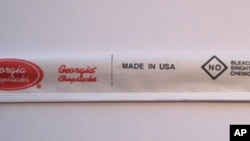
In the United States, many products - such as cameras, computers and mobile phones - carry the label “Made in China.”
But the reverse is happening in the southeastern state of Georgia, where a small company is producing a quintessential Chinese product - chopsticks - for shipment to China and other countries.
Made in the USA
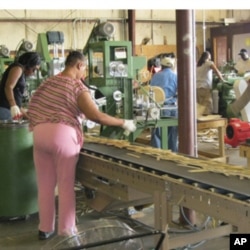
“Right now we are making about two million pairs of chopsticks per day but we are increasing," says Jae Lee, president of Georgia Chopsticks. "End of this month, we’ll have seven machines coming in, so it’ll increase to like four million per day. End of this year, we’ll produce 10 million per day.”
Lee, a Korean-American, says the global market for chopsticks is huge because about one-third of the world’s population uses them. Japan alone goes through about 23 billion pairs of the disposable utensils each year.
Most chopsticks are made in China, where several hundred manufacturers turn out 63 billion pairs annually. But they are running short of wood.
Natural resources
Wood is something the U.S. town of Americus - where Georgia Chopsticks is located - has plenty of.
“Rural Georgia and the cities of rural Georgia, they’re blessed with tons of natural resources," says David Garriga, who heads the local economic development council. "The Pacific Rim, especially areas of China and Japan, they’ve run out of wood, but we have an abundance of it.”
In central Georgia, sweet gum and poplars grow like weeds, and, it turns out, these trees make perfect chopsticks. Their wood is pliable, straight and has a nice color.

That makes Georgia chopsticks especially attractive to consumers since, unlike Asian chopsticks, they do not need to be artificially lightened with chemicals and bleach.
Ramping up production
Americus has something else in abundance, besides wood: people.
Once a manufacturing center, the city lost jobs in the 1970s when companies relocated overseas. Now, Georgia Chopsticks is hiring.
“When I checked, Americus, they have like a 12 percent unemployment rate," says Lee. "In China, everybody believes that labor cost is cheap, but I believe that our quality is much better in the U.S.”
When Georgia Chopsticks opened at the end of last year, it received 450 job applications in just two weeks. Today, 57 people are employed at the factory and Lee hopes to ramp up production, hiring an additional 100 employees by the end of the year.
Susan White, who just started working at the company, thinks it’s great to be turning the tables and making something that is sold in China.
“Everywhere you see in America ‘Made in China,’" she says, "and you wonder if, in China, they ever see ‘Made from America.’”

Level playing field
The American connection to the chopstick trade is something local economic development council head Garriga finds ironic.
“Suddenly here’s a huge nation, fastest growing in the world, that finances part of our national debt, and here we are making their basic products and shipping it to them, like they’ve done for us for years. It’s just kind of a reverse.”
Every chopstick made here goes overseas, where they are sold to supermarket chains in China, Korea and Japan. Right now, Georgia Chopsticks can’t keep up with demand.
It costs less than a penny to make a pair of chopsticks, but Lee isn’t making any money yet. To turn a profit, he needs to produce more than four million chopsticks a day, which he is on track to do in the next month or two.
The success of companies like Georgia Chopsticks demonstrates how the new global economy levels the playing field, according to Garriga.
“Prices and markets have evened out so much that America can produce these basic things and do well in the market.”
Since Georgia Chopsticks started production, Garriga has been contacted by Asian businesses interested in opening other kinds of manufacturing facilities in Americus.
So, chopsticks may be the first in a long line of products produced for Asia, made in Americus and carrying the "Made in the USA" label.