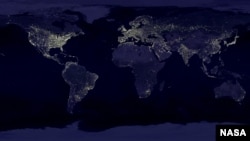
A satellite view of Earth showing the distribution of lights throughout the industrialized and developing worlds. This lighting overpowersbsdrowns out the night sky for the growing number of people who live in those areas. (NASA)
The starry nighttime sky our ancestors knew is disappearing from view for most of the planet’s population.
Rampant artificial light in many parts of the world has become another urban pollutant, erasing our view of the night sky, blinding ground-based telescopes and threatening the health of humans and the planetary ecosystem.
The vanishing night sky is the subject of “The City Dark,” a documentary written and directed by Ian Cheney.
“The film begins with a very simple question," Cheney says. "What do we lose when we lose the night and the darkness and the night sky?”
That’s both a personal and a global question for Cheney, who spent his childhood stargazing on his family’s farm in the rural northeastern state of Maine, and came to miss the night sky after moving to New York as a young man.
"Most kids in the world are now growing up without being able to see the Milky Way galaxy, this band of light that represents the hundreds of millions, the billions, of stars in our home galaxy that our sun is one of," Cheney says. "And we will see, as our people evolve, what that means, whether that means we have fewer scientists, or fewer poets or fewer philosophers. But I certainly think there is no end to the inspiration you can gain from a beautiful view of the night sky.”
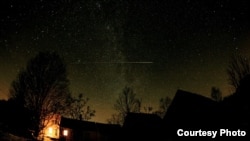
The view of the night sky from the Waldoboro Maine farmhouse where “The City Dark” filmmaker Ian Cheney grew up gazing at the stars (Courtesy Wicked Delicate Films)
Along with inspiration, there is scientific knowledge to be gleaned, as astronomers look to space for clues about the origins of the universe.
But direct observation has become nearly impossible in big cities as their light bounces off the dust in the atmosphere and creates a diffuse pinkish glow that can drown out all but a dozen or so of the brightest stars.
“We’re limited to how far deep in space we can go," College of Staten Island astronomy professor Irving Robbins says in the documentary. "When you look at the sky, it’s like I have a beautiful painting, very nice. But now I come along and erase all of it. I just leave a few spots. That’s what light pollution does.”
It’s easy to understand humanity’s love affair with artificial light. For hundreds of thousands of years, all we had was fire and torchlight to help us move about and feel secure at night. In the early 1800s, gaslight was developed to brighten city streets and deter crime. Incandescent light followed late in the century, helping to create an almost perpetually-illuminated urban world.
“If a light isn’t lighting anything useful, but instead it’s shining into your bedroom window at night or spilling up into the sky, that represents a tremendous waste of energy," Cheney says. "We are burning fossil fuels to create all of this electricity that then is just wasted.”
Cheney believes shielding outdoor lights so they illuminate only the street below is less intrusive and more efficient.
And while city lights help us see where we’re going at night, they actually cause many non-human species to lose their way.
For example, migrating birds seem to have a star map encoded in their brains that helps them navigate as they fly north in the spring and south in the fall. When birds fly over cities, they often confuse the artificial lights below with the stars above.
Dead birds which have been collected by the Field Museum of Chicago after their fatal collisions with buildings. Birds often mistake skyscraper lights for the stars they need to navigate. (Courtesy Wicked Delicate Films)
“Since the lights they are looking at are behind glass, they end up, in many cases, running into the glass and they die from a major concussion," says David Willard, a zoologist at the Field Museum of Chicago. "There are estimates out there that go up to a billion birds a year actually running into windows and dying from those collisions.”
Too much light also interferes with human circadian rhythms, which depend on 24-hour cycles of darkness and light.
Epidemiologist Richard Stevens at the University of Connecticut Health Center says there is evidence linking rising rates of breast cancer in the industrialising world with the growing number of women working night shifts - under artificial light.
“And in fact the International Agency for Research on Cancer, which is part of the World Health Organization, just a couple years ago has now classified shift work as what they call ‘a probable human carcinogen.’"
Lighting manufacturers are responding to growing demand for bulbs that mimic natural light, and efforts are under way around the world to establish “dark sky preserves,” where light pollution is at a minimum.
“The City Dark” filmmaker Cheney is hopeful the night sky can be saved.
“There is something comforting and esthetically pleasing about our city lights,” he says, “we just have to find a way to have them and our stars, too.”