


MOSCOW — Three recent attacks that left 30 people dead and 15 wounded have cast a spotlight on the growing religious warfare in Dagestan, Russia's southernmost republic.
First, a border guard serving near Azerbaijan killed seven colleagues before he was shot dead himself. Superior officers said they had tried twice but failed to have him discharged because he was constantly reading about Wahhabism, a conservative form of Islamic fundamentalism.
Then Georgian special forces said they intercepted a heavily armed unit of Islamic insurgents crossing over from Dagestan. A firefight near the border killed three Georgian soldiers and 12 militants.
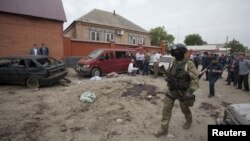
In the most politically significant case, a female suicide bomber attacked Sheikh Said Atsayev, a leading moderate Muslim cleric in Dagestan who had been leading peace talks with militant adherents of Wahhabism, the form of Sunni Islam that is widely practiced in Saudi Arabia. The suicide bomber, the widow of another militant, killed Atsayev and six other people, as well as herself.
Mark Galeotti, a Russian security specialist at New York University, sees an increasingly violent split among the 15 percent of Russians who follow Islam.
"There is an increasing threat that we will really see a Muslim civil war - not just in Dagestan, but across the North Caucasus," Galeotti said.
Violence in Tatarstan
The latest attack in Dagestan followed an incident in Tatarstan, in northern Russia, where assailants tried to kill two moderate Muslim leaders who were seeking the expulsion of Muslim clerics trained in Saudi Arabia. Tatarstan's deputy mufti was killed. The republic's senior mufti was wounded.
President Vladimir Putin traveled to Tatarstan on Tuesday and declared on national television: "Terrorists and militants of all kinds, whatever ideological slogans they may hide behind, always act cynically, behind one's back, and have only one aim - to spread fear and mutual hatred."
The same day, the suicide bomber blew herself up near Sheikh Atsayev.
Alexey Malashenko, an expert on Islam at the Carnegie Moscow Center, says the insurgents' goal is to break away from Russia and its dominant Orthodox Christian faith. "Their main target is the creation of an Islamic state, or caliphate, or Islamic territory," Malashenko said.
But the extremists are hard to fight, because they are often leaderless, and they follow an ideology that glorifies resistance.
"The point of this ideology of jihad is that it encourages individuals to go out and do their own violent thing," Galeotti said. Noting that violence wins publicity, and sometimes draws in recruits to the militants' cause, Galeotti added: "This acts as one of the ways for them to get their message out. Terrorism is, after all, almost always a communicative event."
Unrest Centered in Dagestan
After separatist violence ebbed in Chechnya in the late 2000s, Dagestan emerged as the epicenter of political unrest in southern Russia's four predominantly Muslim republics. Last month, Dagestan accounted for about two-thirds of the 78 people killed in armed violence in the north Caucasus region.
Following the sheikh's assassination, Dagestan's president, Magomedsalam Magomedov, proposed that young men form "self-defense units" and go out on "search and destroy" missions against fundamentalists. There are fears that Atsayev's death may provoke a further escalation of violence. The 75-year-old, white-bearded leader had tens of thousands of devoted followers, many of whom were his former students.
Carnegie analyst Malashenko says a backlash will only provoke more violence, but he contends that doing nothing would be equally bad. "It proves - and it is very important - that Islamic opposition, the so-called Salafis or Wahhabis, can do anything, if they want," Malashenko added.
Moscow's Kommersant newspaper said 80,000 people attended the Sheikh Atsayev's funeral. The newspaper headlined its story: "In Dagestan, Sheikh and Peace Blown Up."
First, a border guard serving near Azerbaijan killed seven colleagues before he was shot dead himself. Superior officers said they had tried twice but failed to have him discharged because he was constantly reading about Wahhabism, a conservative form of Islamic fundamentalism.
Then Georgian special forces said they intercepted a heavily armed unit of Islamic insurgents crossing over from Dagestan. A firefight near the border killed three Georgian soldiers and 12 militants.
In the most politically significant case, a female suicide bomber attacked Sheikh Said Atsayev, a leading moderate Muslim cleric in Dagestan who had been leading peace talks with militant adherents of Wahhabism, the form of Sunni Islam that is widely practiced in Saudi Arabia. The suicide bomber, the widow of another militant, killed Atsayev and six other people, as well as herself.
Mark Galeotti, a Russian security specialist at New York University, sees an increasingly violent split among the 15 percent of Russians who follow Islam.
"There is an increasing threat that we will really see a Muslim civil war - not just in Dagestan, but across the North Caucasus," Galeotti said.
Violence in Tatarstan
The latest attack in Dagestan followed an incident in Tatarstan, in northern Russia, where assailants tried to kill two moderate Muslim leaders who were seeking the expulsion of Muslim clerics trained in Saudi Arabia. Tatarstan's deputy mufti was killed. The republic's senior mufti was wounded.
President Vladimir Putin traveled to Tatarstan on Tuesday and declared on national television: "Terrorists and militants of all kinds, whatever ideological slogans they may hide behind, always act cynically, behind one's back, and have only one aim - to spread fear and mutual hatred."
The same day, the suicide bomber blew herself up near Sheikh Atsayev.
Alexey Malashenko, an expert on Islam at the Carnegie Moscow Center, says the insurgents' goal is to break away from Russia and its dominant Orthodox Christian faith. "Their main target is the creation of an Islamic state, or caliphate, or Islamic territory," Malashenko said.
But the extremists are hard to fight, because they are often leaderless, and they follow an ideology that glorifies resistance.
"The point of this ideology of jihad is that it encourages individuals to go out and do their own violent thing," Galeotti said. Noting that violence wins publicity, and sometimes draws in recruits to the militants' cause, Galeotti added: "This acts as one of the ways for them to get their message out. Terrorism is, after all, almost always a communicative event."
Unrest Centered in Dagestan
After separatist violence ebbed in Chechnya in the late 2000s, Dagestan emerged as the epicenter of political unrest in southern Russia's four predominantly Muslim republics. Last month, Dagestan accounted for about two-thirds of the 78 people killed in armed violence in the north Caucasus region.
Following the sheikh's assassination, Dagestan's president, Magomedsalam Magomedov, proposed that young men form "self-defense units" and go out on "search and destroy" missions against fundamentalists. There are fears that Atsayev's death may provoke a further escalation of violence. The 75-year-old, white-bearded leader had tens of thousands of devoted followers, many of whom were his former students.
Carnegie analyst Malashenko says a backlash will only provoke more violence, but he contends that doing nothing would be equally bad. "It proves - and it is very important - that Islamic opposition, the so-called Salafis or Wahhabis, can do anything, if they want," Malashenko added.
Moscow's Kommersant newspaper said 80,000 people attended the Sheikh Atsayev's funeral. The newspaper headlined its story: "In Dagestan, Sheikh and Peace Blown Up."