


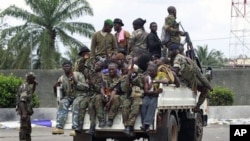
Forces backing Ivory Coast's internationally recognized president, Alassane Ouattara, are blockading the presidential compound where the country's incumbent leader is refusing to surrender.
In a broadcast on his television network, Ouattara called on his forces to maintain discipline and restore order in Abidjan.
It is a reversal in the four month political crisis, when Ouattara was blockaded in a resort hotel, surrounded by Gbagbo's forces. Many of those soldiers have surrendered to United Nations peacekeepers as pro-Ouattara forces take control of the commercial capital.
Those forces renewed their offensive on the presidential residence on Thursday, after Gbagbo fighters held off an attack with heavy weapons.
French Defense Minister Gerard Longuet says Gbagbo now has fewer than 1,000 troops in Abidjan, some 200 of whom are defending the compound where he is holding out in a bunker, refusing to acknowledge that he lost last November's presidential election.
French and United Nations officials were unable to negotiate Gbagbo's surrender when he refused to recognize Ouattara as the country's duly-elected president.
Gbagbo supporters say their leader never intended to surrender and opened talks only to negotiate a ceasefire after French and U.N. attack helicopters destroyed heavy weapons at the presidential residence and the main barracks.
In Paris, the incumbent president's adviser Alain Toussaint says Ouattara will never see Mr. Gbagbo surrender.
"Mr. Gbagbo will never surrender to anyone - not to the Ouattara rebellion, not to the United Nations, not even to France," he said.
Toussaint says Mr. Gbagbo is the elected president of Ivory Coast because of the results declared by the constitutional council.
Gbagbo's claim to the presidency is based on the constitutional council annulling as fraudulent nearly 10 percent of the ballots cast in his run-off election with Ouattara. Ouattara's claim is based on electoral commission results certified by the United Nations.
Hundreds of people have died since fighting began in December, including many civilians. The United Nations is investigating violence last week near the Liberian border. In his broadcast late Thursday, Ouattara said "light will be shed on all crimes," and he ordered his fighters to be "exemplary in their behavior" and abstain from any act of violence against civilians.
View related slide show