


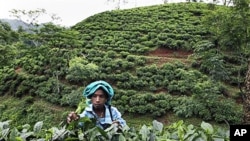
In India's main tea-growing region, scientists say tea production is being impacted by climate change. India produces nearly one third of the world's tea.
The rolling Himalayan hills in India's northeastern state, Assam, are carpeted with lush tea bushes whose leaves produce some of the world's finest teas.
But there are concerns that rising temperatures may be affecting the tea plantations, resulting in declining productivity of the brew to which millions of people across the world wake up.
The director of the Tea Research Association in Assam, Mridul Hazrika, is studying the impact of climate change on tea production.
"We have observed that minimum temperature has rise[n] by two degrees centigrade and there is a reduction in the rainfall in the last 90 years by around 200 millimeters. And this is very important, very significant from the point of tea as a plantation crop," Hazrika said.
Scientists say rising temperatures can affect the ability of the tea bush to grow. Tea production in the Assam region has declined in recent years, although the area under cultivation has risen.
Erratic rainfall patterns are of particular concern to planters because the tea plant is largely dependent on the weather. They point out that last year there were fewer days with sunshine, resulting in humid conditions which are unfavorable for the growth of the tea plant.
Planters are optimistic that the sturdy tea bush will adapt, but they are looking at ways to combat the impact of climate change.
Arijit Raha is an official with the Indian Tea Association, based in Kolkata.
"The industry has been looking at irrigation as an option, but tea plantations are huge, irrigating 100 percent is a very expensive proposition," Raha said. "One is also looking at other options, drought-resistant plants but those are things which will come in the future."
There have been some reports that the flavor of the Assam tea, known to produce a strong cup of tea, has also been impacted.
But the chairman of the Indian Tea Association, C.S. Bedi, dismisses any link between quality of the tea and climate change. He says other reasons may be responsible for this.
"I belong to a generation which in many ways has systematically gone in for very high fertilization," Bedi said. "That has affected quality I am certain. It's gone in for very high pesticide application, for very high herbicidal application. When you look back in hindsight, these were not really the best environmental friendly operations…Today we are looking at correcting things. We are looking for more organic products, we are looking at organic teas."
Assam produces more than half of India's tea. India accounts for nearly one-third of the world's tea production.