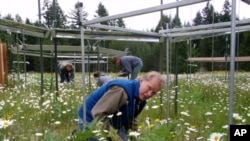
Researchers from the University of Oregon have set up a kind of time machine to test how a warmer climate might affect grasslands and prairies around the world.
Today, grasslands cover between 25 and 40 percent of the earth's land surface. The researchers want to see what happens to biodiversity as the climate warms.
Will invasive species start to dominate the landscape? Will different native plants move in? What about the native species trying to survive now?
Ecologist Scott Bridgham helped design the experiment, which uses watering hoses and circles of electric heat lamps. He's one of the leaders of the University of Oregon team trying to mimic what climatologists predict for this region 50 to 80 years from now.
The chest-high outdoor heat lamps aim to keep the plants in the experiment at a constant three degrees Celsius hotter than they would be otherwise. Sprinklers add further realism to the model.
The researchers have set up their windows-on-the-future at three widely-spaced nature preserves in western Oregon and Washington state. At each location, the team has staked out experimental plots in a prairie. Some circles get extra heat and rain on top of what nature currently provides and others are left alone to serve as controls.
More wildflowers bloom in a heated (left) vs. untreated control plot (right).
"Climate change may be good for some of these species," says Bridgham. "It may be bad for some of these species. And so we're trying to sort that out."
Bart Johnson, the co-principal investigator, says all the team members periodically get on their hands and knees to count and measure. "It's very difficult to predict. I think there's no better way to do it than an empirical study like this where we are putting additional heat out here and seeing what the effects are."
At the northernmost of the three sites is a prairie being restored by the private environmental group called The Nature Conservancy. White oxeye daisies catch the eye alongside colorful ground-hugging natives such as blue lupines, purple owl's clover, green bracken fern and a yellow flower called Oregon sunshine. The researchers collect data here.
Some of the plots with heat lamps have more flowers.
"It's kind of cold," says Johnson. "The plants under the heater lamps are not unhappy at all about having a little extra heat right now."
However, other plants flourish in the cold.
"When we go all the way down to southern Oregon, what we have seen there is that there are a small number of the introduced species which are quite invasive that do really well on the plots because now they have cold winters down there, but they have enough warmth and enough moisture in the heated plots to grow very rapidly," says Johnson. "They are emerging before the native species are and tending to smother out the other plants."
Johnson says having a string of experimental plots stretching 600 kilometers from south to north could also allow the researchers to predict shifts in the ranges of native and exotic plants. Bridgham says the team hopes to extrapolate their results to other regions of the world.
The University of Oregon team received $1.8 million from the U.S. Department of Energy to study climate impacts on dwindling prairies for three growing seasons. They're about halfway to the finish line.