


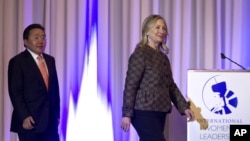
ULAANBAATAR — U.S. Secretary of State Hillary Clinton is in Mongolia where she is championing the economic benefits of democracy on a trip meant to reinforce the Obama administration's pivot toward Asia.
Secretary Clinton says her trip reflects a strategic priority of U.S. foreign policy: after ten years in which the United States had to focus on conflicts in Iraq and Afghanistan, Washington is now boosting diplomatic, economic and strategic investments in Asia.
"We want to help build an open, stable and just regional order in the Asia-Pacific based on norms and institutions that benefit all nations and all peoples," she said.
Washington's so-called Asia pivot has been seen warily by China, especially the realignment of U.S. military forces and calls for greater civil liberties.
In a speech to the International Women's Leadership Forum in the Mongolian capital, Secretary Clinton did not mention China by name. Instead, she compared authoritarian rule with political progress in Taiwan, Burma, Thailand, the Philippines and East Timor.
"These and other achievements across the region show what is possible," she said. "And, they stand in stark contrast to those governments that continue to resist reforms, that work around the clock to restrict people's access to ideas and information, to imprison them for expressing their views, to usurp the rights of citizens to choose their leaders, to govern without accountability, to corrupt the economic progress of the country and take the riches unto themselves."
Although Clinton says there are some countries in Asia that have made economic progress without political liberalism, she calls those short-term gains.
"Countries that want to be open for business but closed to free expression will find the approach comes with a cost. It kills innovation and discourages entrepreneurship, which are vital for sustainable growth," she said.
Clinton says together, security, economic progress and common values undergird Washington's vision of a region that is peaceful and prosperous.
"We need to make the 21st Century a time in which people across Asia don't only become wealthy. They must also become more free," she said.
Here in Mongolia there is some concern about the April arrest of the former president Nambaryn Enkhbayar on corruption charges. Secretary Clinton met privately with the current president, Tsakhia Elbegdorj, at the downtown Government House.
A senior State Department official says Washington celebrates a series of successful elections in Mongolia while stressing that the international community is watching how the rule of law is applied.
In her public comments, Secretary Clinton praised President Elbegdorj as an example for the region, saying, "If you want to see democracy in action, if you want to see progress being shaped by leaders more concerned about lifting up their people than fattening up their bank accounts, come to Mongolia."
From Mongolia, the secretary of state travels to Vietnam, Laos and Cambodia where she will join regional foreign ministers at a meeting of the Association of South East Asian Nations. Those talks are expected to include political reforms in Burma and the Chinese/Vietnamese/Filipino standoff over the South China Sea.
Secretary Clinton says her trip reflects a strategic priority of U.S. foreign policy: after ten years in which the United States had to focus on conflicts in Iraq and Afghanistan, Washington is now boosting diplomatic, economic and strategic investments in Asia.
"We want to help build an open, stable and just regional order in the Asia-Pacific based on norms and institutions that benefit all nations and all peoples," she said.
Washington's so-called Asia pivot has been seen warily by China, especially the realignment of U.S. military forces and calls for greater civil liberties.
In a speech to the International Women's Leadership Forum in the Mongolian capital, Secretary Clinton did not mention China by name. Instead, she compared authoritarian rule with political progress in Taiwan, Burma, Thailand, the Philippines and East Timor.
"These and other achievements across the region show what is possible," she said. "And, they stand in stark contrast to those governments that continue to resist reforms, that work around the clock to restrict people's access to ideas and information, to imprison them for expressing their views, to usurp the rights of citizens to choose their leaders, to govern without accountability, to corrupt the economic progress of the country and take the riches unto themselves."
Although Clinton says there are some countries in Asia that have made economic progress without political liberalism, she calls those short-term gains.
"Countries that want to be open for business but closed to free expression will find the approach comes with a cost. It kills innovation and discourages entrepreneurship, which are vital for sustainable growth," she said.
Clinton says together, security, economic progress and common values undergird Washington's vision of a region that is peaceful and prosperous.
"We need to make the 21st Century a time in which people across Asia don't only become wealthy. They must also become more free," she said.
Here in Mongolia there is some concern about the April arrest of the former president Nambaryn Enkhbayar on corruption charges. Secretary Clinton met privately with the current president, Tsakhia Elbegdorj, at the downtown Government House.
A senior State Department official says Washington celebrates a series of successful elections in Mongolia while stressing that the international community is watching how the rule of law is applied.
In her public comments, Secretary Clinton praised President Elbegdorj as an example for the region, saying, "If you want to see democracy in action, if you want to see progress being shaped by leaders more concerned about lifting up their people than fattening up their bank accounts, come to Mongolia."
From Mongolia, the secretary of state travels to Vietnam, Laos and Cambodia where she will join regional foreign ministers at a meeting of the Association of South East Asian Nations. Those talks are expected to include political reforms in Burma and the Chinese/Vietnamese/Filipino standoff over the South China Sea.