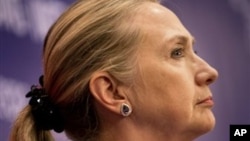
U.S. Secretary of State Hillary Rodham Clinton, in Cambodia Friday, visits Egypt this weekend to meet its new president, Mohamed Morsi of the Muslim Brotherhood.
CAIRO -- U.S. Secretary of State Hillary Clinton visits Egypt over the weekend to meet the nation's first freely elected president, Mohamed Morsi, a member of the Muslim Brotherhood whose Islamist followers want to reassess the previously close relations between Washington and Cairo.
Clinton's visit, scheduled to begin Sunday, comes as many Egyptians are increasingly concerned about what they consider American interference in the domestic affairs of this Arab nation of more than 80 million people.
High on the agenda for the secretary of state's meeting with President Morsi are likely to be Egypt's political transition, its struggling economy, its peace treaty with Israel, and U.S. aid totaling more than $1 billion a year.
Manar Shorbagy, a professor of political science at the American University in Cairo, says in this new phase, the United States must reassess how it deals with Egypt.
“On the part of the United States, I hope that the United States would redefine its interests in the region because so far it has been defining its interests in the region as oil and protection of Israel," Shorbagy says. "I think there is more to the Egyptian-American relationship than to do just that. It will be important to have a relationship with Egypt based on the mutual interests with Egypt.”
Egyptians want respect
She says through the Arab Spring revolution, Egyptians demanded that their own government treat them with dignity and respect, and this will now also carry over to how they deal with the rest of the world.
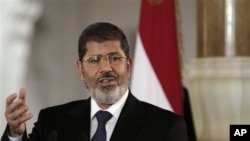
Egyptian President Mohammed Morsi speaks to reporters after meeting Tunisian President Moncef Marzouki in Cairo, Friday, July 13.
That is a popular sentiment in Egypt in the days after Mohamed Morsi was declared Egypt's first Islamist president last month. On a busy Cairo street, a mid-level government employee says Egyptians simply want respect.
“We don't ask for a lot, we don't want them to provide us the same [aid] they give Israel or the whole region," says Ahmed, an Agriculture Ministry accountant who gave only his first name. "But what is best for us - democracy, development, whatever it is - we need them to support this without looking to the gas, without looking to the strategic Suez Canal, without looking to Iran, without looking to Syria. We are a country.”
President Obama's visit recalled
In 2009, President Barack Obama came to Cairo and made a historic speech about a “new beginning” between the United States and the Arab and Muslim world. He talked about erasing years of mistrust, finding common ground and relations based on mutual respect.
Political scientist Shorbagy says while the intentions of this speech were good, they may have inadvertently produced the opposite effect.
“What I think happened during the last couple of years is that the Obama speech in Cairo has actually heightened the expectations and none of the promises have materialized which actually made things worse,” she says.
The disappointment is reflected in a Gallup poll published in March that found that more than half of the Egyptians surveyed saw closer relations with Washington as a bad thing.
Mohamed, 20, a history teacher, says he has not seen any difference in how the U.S. deals with Arab dictators or the Palestinian issue since the Obama speech. No, he says, it is just talk and talk leads nowhere.
Part of this frustration may come from the $1.4 billion a year in military aid and the $250 million a year that the U.S. spends on economic and political programs here. Another Gallup survey found recently that only a quarter of Egyptians polled favor continuing that assistance.
Much of that aid money comes with conditions, and Egyptians like Mohamed Galal, taking a break in the mid-day heat to smoke a water pipe, resents that.
"You do not give me aid and then tell me to do this," says Galal. "You cannot control me."