


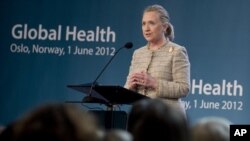
OSLO, Norway - The United States and Norway are working to improve maternal and child health in Africa. In the Norwegian capital, Secretary of State Hillary Clinton pledged $75 million in U.S. support.
Secretary Clinton says the "Saving Mothers, Giving Life" initiative aims to reduce maternal mortality at a time when the World Health Organization says 800 women die in childbirth each day.
"I often think about issues like maternal health from a personal perspective because I am privileged to have known what it meant to me to have had the great good fortune and gift of my daughter," said Clinton. "And I think about what it would have been like that cold February day in 1980 if I didn't know that the facility was available. Or were it available, I didn't really know for sure if it would be open. And I couldn't count on a doctor or a midwife or a nurse being present."
The initiative is sponsored by the U.S. and Norwegian governments along with the pharmaceutical firm Merck and the American College of Obstetricians and Gynecologists.
Starting in Uganda and Zambia, it is focusing on helping mothers during labor, delivery, and during the first 24 hours after a birth, when two of every three maternal deaths occur and 45 percent of newborn deaths occur.
The public and private partnership is meant to strengthen district health services by building clinics and labs, training staff, improving supply chains, making blood supplies safe, and improving record-keeping systems.
Secretary Clinton says better health systems can not be imposed from outside any more than democracy can be imposed. So each country must shape its own approach based on individual needs and priorities.
But she says there are some universal fundamentals: governments increasing their own spending, donors embracing transparency, and lawmakers bringing down barriers to better health care, including regulatory changes allowing for the faster approval of new drugs.
"It means repealing laws that stop progress, like the unfortunate treatment of women in so many places," said Clinton. "Ending gender-based violence and discrimination. Creating true health equality for women and men. In some countries, women and girls are considered inherently less valuable than men and boys, and they’re treated that way by custom and law."
The "Saving Mothers, Giving Life" program is part of the Obama administration's 2009 Global Health Initiative, which also includes funding to improve nutrition and reproductive health while combating HIV/AIDS, Malaria, and Tuberculosis.
Secretary Clinton says the "Saving Mothers, Giving Life" initiative aims to reduce maternal mortality at a time when the World Health Organization says 800 women die in childbirth each day.
"I often think about issues like maternal health from a personal perspective because I am privileged to have known what it meant to me to have had the great good fortune and gift of my daughter," said Clinton. "And I think about what it would have been like that cold February day in 1980 if I didn't know that the facility was available. Or were it available, I didn't really know for sure if it would be open. And I couldn't count on a doctor or a midwife or a nurse being present."
The initiative is sponsored by the U.S. and Norwegian governments along with the pharmaceutical firm Merck and the American College of Obstetricians and Gynecologists.
Starting in Uganda and Zambia, it is focusing on helping mothers during labor, delivery, and during the first 24 hours after a birth, when two of every three maternal deaths occur and 45 percent of newborn deaths occur.
The public and private partnership is meant to strengthen district health services by building clinics and labs, training staff, improving supply chains, making blood supplies safe, and improving record-keeping systems.
Secretary Clinton says better health systems can not be imposed from outside any more than democracy can be imposed. So each country must shape its own approach based on individual needs and priorities.
But she says there are some universal fundamentals: governments increasing their own spending, donors embracing transparency, and lawmakers bringing down barriers to better health care, including regulatory changes allowing for the faster approval of new drugs.
"It means repealing laws that stop progress, like the unfortunate treatment of women in so many places," said Clinton. "Ending gender-based violence and discrimination. Creating true health equality for women and men. In some countries, women and girls are considered inherently less valuable than men and boys, and they’re treated that way by custom and law."
The "Saving Mothers, Giving Life" program is part of the Obama administration's 2009 Global Health Initiative, which also includes funding to improve nutrition and reproductive health while combating HIV/AIDS, Malaria, and Tuberculosis.